


Mortgage Do's And Don'ts
Mortgages can be tricky, and it's easy to make mistakes that can end up costing you dearly. That's why we've put together this list of Mortgage Do's and Do not's to help you navigate the process with ease - and a little bit of humor.
DO: Shop around for the best mortgage rates
DON'T: Assume your bank will give you the best rate just because you have a checking account there. Remember, loyalty is a two-way street.
DO: Have a budget in mind
DON'T: Get in over your head. Just because you can technically afford a million-dollar mansion doesn't mean you should buy one. You don't want to be house-poor and unable to afford groceries.

DO: Get pre-approved before house-hunting
.
DON'T: Assume you'll be approved for a mortgage just because you have good credit. Pre-approval is important because it gives you a better idea of how much house you can afford and shows sellers that you're serious.
.
DO: Consider your future plans
.
DON'T: Assume you'll live in your new house forever. Life happens, and you may need to sell sooner than you think. Make sure you're not getting into a mortgage that you can't realistically afford if you need to move in a few years.
DO: Get pre-approved before house-hunting
.
DON'T: Assume you'll be approved for a mortgage just because you have good credit. Pre-approval is important because it gives you a better idea of how much house you can afford and shows sellers that you're serious.
.
DO: Consider your future plans
.
DON'T: Assume you'll live in your new house forever. Life happens, and you may need to sell sooner than you think. Make sure you're not getting into a mortgage that you can't realistically afford if you need to move in a few years.
DO: Read the fine print
.
DON'T: Sign on the dotted line without reading the terms and conditions. There may be hidden fees or clauses that could come back to haunt you later.
.
DO: Be prepared for unexpected expenses
.
DON'T: Assume everything will go smoothly. There may be unforeseen expenses, like a leaky roof or a broken furnace, that can quickly drain your savings. Be sure to budget for these types of surprises.

DO: Read the fine print
.
DON'T: Sign on the dotted line without reading the terms and conditions. There may be hidden fees or clauses that could come back to haunt you later.
.
DO: Be prepared for unexpected expenses
.
DON'T: Assume everything will go smoothly. There may be unforeseen expenses, like a leaky roof or a broken furnace, that can quickly drain your savings. Be sure to budget for these types of surprises.

DO: Have a good sense of humor
.
DON'T: Take everything too seriously. Yes, buying a house and getting a mortgage can be stressful, but try to find the humor in the situation. After all, laughter is the best medicine for a stressful day.
.
By following these Mortgage Do's and Do not's, you'll be well on your way to successfully navigating the mortgage process - with a smile on your face. Good luck, and happy house hunting!
Blogs
The Top 5 Mortgage Mistakes to Avoid

Buying your first home can be both exciting and nerve-wracking at the same time. With so many things to consider and....
Mortgage Do and
Do not list

Mortgages can be tricky, and it's easy to make mistakes that can end up costing you dearly. That's why we've put together this list....
Tips On How To Improve Your Credit Score

Let's talk about some ways you can improve your credit score! Your credit score is actually a big deal, and it can affect...
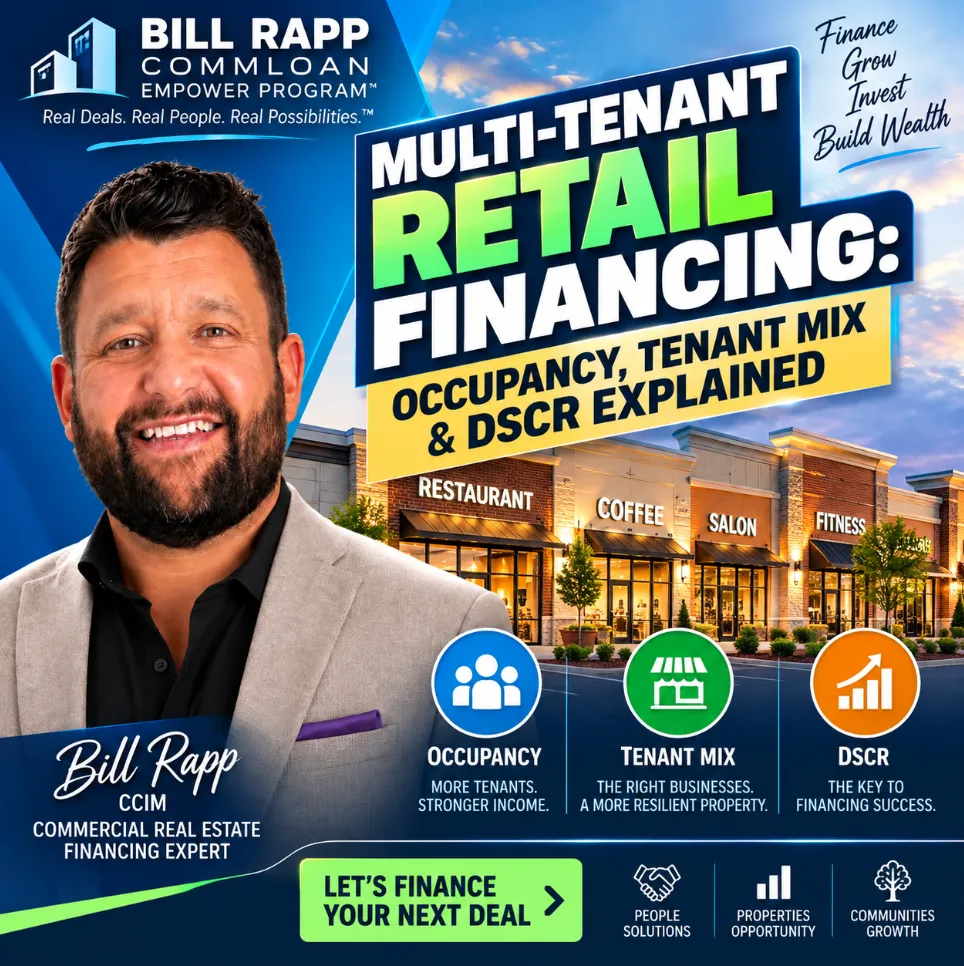
🏬 Multi-Tenant Retail Financing: How Occupancy, Tenant Mix & DSCR Determine Your Loan 💰
🏬 Multi-Tenant Retail Financing: How Occupancy, Tenant Mix & DSCR Determine Your Loan 💰
📊 Financing a Shopping Center? Why Occupancy, Tenant Mix & DSCR Matter to Commercial Lenders 🏦
________________________________________________________________________________
Multi-Tenant Retail Financing: Occupancy, Tenant Mix & DSCR Explained
Financing a multi-tenant retail property involves much more than determining the property's value and applying a loan-to-value ratio.
For shopping centers, neighborhood retail centers, strip centers, and other multi-tenant properties, lenders need to understand where the property's cash flow comes from—and how durable that cash flow is likely to be.
Three factors can become particularly important:
Occupancy. Tenant mix. Debt Service Coverage Ratio (DSCR).
A retail center may look strong on paper, but lease expirations, tenant concentration, vacancies, weak tenants, or insufficient DSCR can materially affect the financing available to an investor.
Understanding these issues before approaching lenders can help CRE investors structure stronger transactions and avoid financing surprises.
Why Multi-Tenant Retail Financing Is Different
With a single-tenant property, lenders can focus heavily on one lease, one tenant, and one stream of rental income.
Multi-tenant retail requires a broader analysis.
The lender may evaluate the property's:
·Current physical and economic occupancy
·Historical occupancy
·Tenant roster and credit quality
·Lease expiration schedule
·Tenant concentration
·Anchor and junior-anchor exposure
·Local versus national tenants
·Remaining lease terms
·Rent levels relative to market
·Expense reimbursements
·Historical and underwritten NOI
·DSCR and debt yield
The question isn't simply, "What is the property worth?"
It is also:
"How dependable is the income supporting the proposed loan?"
1. Occupancy: 90% Occupied Doesn't Tell the Whole Story
Occupancy is one of the first metrics an investor may present to a lender.
Suppose a shopping center is 90% occupied. That sounds positive, but the lender's analysis generally doesn't end there.
The lender may want to know whether the occupancy has been stable or whether the property recently leased several previously vacant suites. They may also examine delinquent tenants, free-rent periods, tenant improvement obligations and leases scheduled to expire soon.
Physical occupancy and economic occupancy aren't necessarily identical.
A tenant may occupy space while paying below-market rent, receiving concessions, or experiencing payment problems.
Conversely, a property with some vacancy may still present an attractive financing opportunity if the occupied space generates strong cash flow and the sponsorship, market and leasing strategy support the transaction.
2. Tenant Mix: Diversification Can Matter
Imagine two shopping centers that each generate $500,000 of NOI.
Property A has ten tenants with relatively diversified income.
Property B generates 45% of its rental revenue from one tenant.
The NOI may currently be identical, but the income streams have different concentration risks.
If Property B's major tenant leaves, the property's cash flow could change dramatically.
That's why lenders may analyze tenant concentration alongside occupancy.
A diversified tenant mix can potentially reduce reliance on any single tenant, although diversification alone doesn't eliminate leasing risk.
Lenders may also consider how the tenants complement each other.
A neighborhood retail center could contain businesses such as restaurants, medical users, salons, fitness concepts, professional services, and other service-oriented tenants.
The strength of that mix depends on the property, market, leases, tenant financial strength and other factors—not simply the number of tenants.
3. The Rent Roll Can Tell the Story
One of the most important documents in a multi-tenant retail financing request is the rent roll.
A lender may use it to understand:
Who occupies the property? How much space does each tenant lease? What rent does each tenant pay? When does each lease expire?
The rent roll also helps identify potential concentration and rollover risk.
For example, consider a property that is 95% occupied today but has 40% of its leased square footage expiring during the next 18 months.
That expiration schedule may be more important to underwriting than the headline occupancy number.
This is why commercial real estate investors should review the lease expiration schedule well before refinancing or purchasing a retail center.
4. What Is DSCR?
Debt Service Coverage Ratio, or DSCR, measures the relationship between a property's qualifying net operating income and its required debt service.
A simplified formula is:
DSCR = Net Operating Income ÷ Annual Debt Service
Suppose a property generates $300,000 of underwritten NOI and the proposed mortgage requires $240,000 of annual debt service.
The DSCR would be:
$300,000 ÷ $240,000 = 1.25x DSCR
In simplified terms, the property generates $1.25 of NOI for every $1.00 of annual debt service.
Actual lender calculations can vary because lenders may make adjustments to income, vacancy, expenses, reserves, management fees and other underwriting items.
5. Why DSCR Can Limit Loan Proceeds
This is where some borrowers encounter an unexpected result.
Suppose the appraisal supports the borrower's requested loan based on the lender's maximum LTV.
That doesn't necessarily mean the borrower receives that amount.
The proposed debt must still satisfy the lender's other underwriting requirements.
If interest rates rise, annual debt service can increase. Higher debt service can reduce DSCR even when the property's NOI hasn't changed.
As a result, the DSCR constraint may support a smaller loan than the LTV constraint.
Depending on the lender and transaction, debt yield and other credit metrics can create additional constraints.
The maximum loan amount is therefore not necessarily determined by the appraisal alone.
6. Tenant Rollover Can Affect Underwriting
Lease rollover is especially important with multi-tenant retail.
Consider a shopping center where several major leases expire shortly after the proposed loan closes.
The property may have excellent occupancy today, but the lender must consider what happens if those tenants don't renew.
Questions can include:
Will the tenant renew?
Is its current rent above or below market?
How difficult would the space be to re-lease?
What tenant improvements and leasing commissions might be required?
How much downtime could occur?
The greater the near-term rollover exposure, the more attention lenders may give the property's leasing history, reserves, sponsorship and market fundamentals.
7. Strong Value Does Not Automatically Mean Maximum Leverage
This is one of the most important concepts for retail investors to understand.
Appraised value and borrowing capacity are related—but they aren't the same thing.
A property could receive an excellent appraisal while still being constrained by cash flow.
Commercial lenders may simultaneously consider:
LTV + DSCR + Debt Yield + Tenant Risk + Sponsor Strength + Loan Structure
Different lenders can also evaluate these factors differently.
That helps explain why the same retail property can receive materially different financing proposals from different lenders.
8. Prepare the Financing Package Before Shopping the Loan
A well-organized financing package can make the lender's initial review substantially easier.
For an existing multi-tenant retail property, investors should generally be prepared to provide current operating and property information such as a rent roll, historical property financials, lease information, borrower financial information and a clear explanation of the requested financing.
For an acquisition, the purchase contract and offering materials may also be relevant.
For a refinance, lenders will typically need information about the existing debt and the purpose of any requested cash-out proceeds.
The exact documentation depends on the lender, property and transaction.
Why a Commercial Mortgage Marketplace Can Help
Multi-tenant retail properties don't always fit neatly into a single lending box.
Banks, credit unions, debt funds, bridge lenders, agency lenders, CMBS lenders and other capital sources can have different appetites, underwriting requirements and structures.
That's where the CommLoan Empower Program can provide value.
Rather than beginning with one lender and attempting to make the transaction fit that lender's program, the process can begin with the deal itself.
What is the NOI?
What does the rent roll look like?
Where is the rollover risk?
What leverage does the borrower need?
What DSCR does the property support?
What is the borrower's business plan?
From there, the objective is to identify lending programs aligned with the transaction.
Final Takeaway
When financing a multi-tenant retail property, don't focus exclusively on the appraisal or occupancy percentage.
Study the income behind those numbers.
Occupancy tells part of the story.
Tenant mix tells another part.
The rent roll reveals concentration and rollover exposure.
And DSCR helps determine how much debt the property's cash flow can reasonably support under a particular lender's underwriting.
Understanding those factors before approaching the lending market can help investors identify financing challenges earlier and evaluate potential loan structures more effectively.
Top of Form
Bottom of Form
Bill Rapp, CCIM
Director | CommLoan
📞 281-222-0433
📧 [email protected]
🌐 https://billrapp.commloan.com/
🌐 https://HoustonCommercialMortgage.com/
Commercial Real Estate Financing Nationwide
https://billrapp.commloan.com/
https://author.billrapponline.com/
https://www.amazon.com/dp/B0F32Z5BH2
https://veed.cello.so/FOmzTty6oi9
https://buymeacoffee.com/vikingente3
https://creplaybookseries.billrapponline.com
https://creplaybook.billrapponline.com/
©Bill Rapp, CCIM - Director - CommLoan

10 Tips for First-Time Homebuyers

Buying your first home can be both exciting and nerve-wracking at the same time. With so many things to consider and....
How To Choose the Right Lender for You

Lorem Ipsum is simply dummy text of the printing and typesetting industry. Lorem Ipsum has been the industry's standard dummy
Refinancing youe loan and when to do it

Lorem Ipsum is simply dummy text of the printing and typesetting industry. Lorem Ipsum has been the industry's standard dummy
🧮 Renovation ROI Calculator
🛠️ Renovation ROI Calculator 💰

Copyright ©2021 | Mortgage Viking Team Licensed to Do Business | NMLS # 228246
This is not an offer to enter into an agreement. Not all customers will qualify. Information, rates and programs are subject to change without notice. All products are subject to credit and property approval. Other restrictions and limitations may apply
Corporate | NMLS ID NMLS # 1825831
Corporate Address : 2651 N. Green Valley Pkwy STE. 101 Henderson, NV 89014 https://medallionfunds.com/bill-rapp/