


Tips on How to Improve Your Credit Score
Hey folks, it's time to get real about your credit score. If you're anything like me, you probably don't pay much attention to it until it's time to apply for a loan or credit card. But did you know that your credit score can make or break your ability to obtain a mortgage loan?
.
When you apply for a mortgage loan, lenders take a close look at your credit score and credit history. They want to know if you're a responsible borrower who will pay back the loan on time and in full. A good credit score can help you qualify for a mortgage loan with a lower interest rate and better terms, while a poor credit score can make it more difficult to get approved and result in higher interest rates and less favorable terms.
.
In short, your credit score is one of the most important factors that lenders consider when deciding whether to approve you for a mortgage loan. By taking steps to improve your credit score, you can increase your chances of getting approved for a loan with better terms and save yourself thousands of dollars in the process.

1. Check your credit report regularly
This is a no-brainer, but it's worth repeating. Make sure to check your credit report for any errors or fraudulent activity. You can get a free credit report from each of the three major credit bureaus every year, so take advantage of it.
2. Pay your bills on time
This one seems obvious, but it's worth emphasizing. Late payments can have a big impact on your credit score, so set up automatic payments or reminders to make sure you're always on time.
3. Lower your credit utilization ratio
Your credit utilization ratio is the amount of credit you're using compared to your credit limit. Aim to keep your utilization ratio under 30% to improve your score.
1. Check your credit report regularly
This is a no-brainer, but it's worth repeating. Make sure to check your credit report for any errors or fraudulent activity. You can get a free credit report from each of the three major credit bureaus every year, so take advantage of it.
2. Pay your bills
on time
This one seems obvious, but it's worth emphasizing. Late payments can have a big impact on your credit score, so set up automatic payments or reminders to make sure you're always on time.
3. Lower your credit utilization ratio
Your credit utilization ratio is the amount of credit you're using compared to your credit limit. Aim to keep your utilization ratio under 30% to improve your score.
4. Increase your credit limit
If you're struggling to keep your credit utilization ratio low, consider asking for a credit limit increase. Just make sure not to use the extra credit as an excuse to spend more.
5. Diversify your credit
Having a mix of credit types (like a credit card, auto loan, and mortgage) can improve your credit score. But don't open new accounts just to add diversity - only take on credit that you actually need and can handle responsibly.

4. Increase your
credit limit
If you're struggling to keep your credit utilization ratio low, consider asking for a credit limit increase. Just make sure not to use the extra credit as an excuse to spend more.
5. Diversify your credit
Having a mix of credit types (like a credit card, auto loan, and mortgage) can improve your credit score. But don't open new accounts just to add diversity - only take on credit that you actually need and can handle responsibly.
Blogs
The Top 5 Mortgage Mistakes to Avoid

Buying your first home can be both exciting and nerve-wracking at the same time. With so many things to consider and....
Mortgage Do and
Do not list

Mortgages can be tricky, and it's easy to make mistakes that can end up costing you dearly. That's why we've put together this list....
Tips On How To Improve Your Credit Score

Let's talk about some ways you can improve your credit score! Your credit score is actually a big deal, and it can affect...
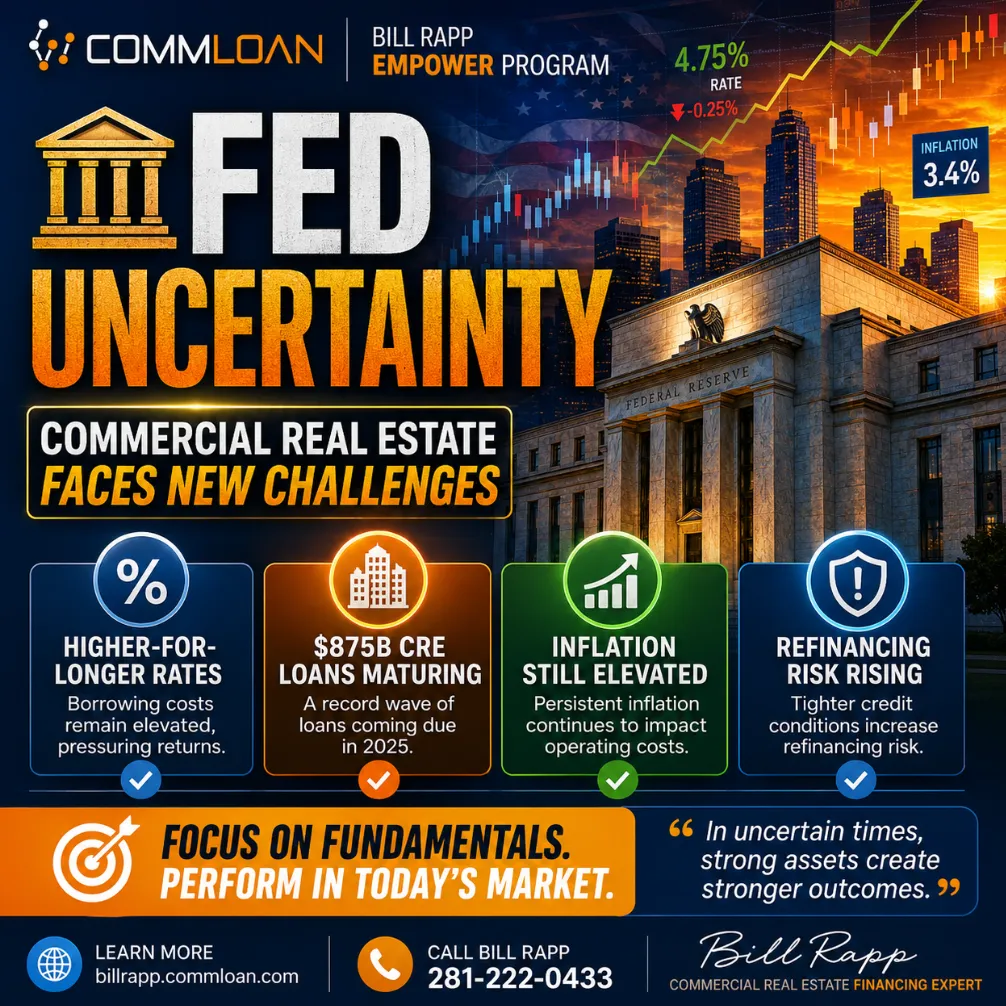
🏦 Federal Reserve Uncertainty Creates New Risks for Commercial Real Estate Investors 📈
🏦 Federal Reserve Uncertainty Creates New Risks for Commercial Real Estate Investors 📈
⚠️ Higher-for-Longer Rates: How the Fed's New Strategy Is Reshaping Commercial Real Estate 🏢
The Federal Reserve's New Approach Creates Fresh Challenges for Commercial Real Estate
The commercial real estate industry has spent the last several years closely watching every word coming from the Federal Reserve. Investors, lenders, developers, and business owners have relied heavily on Federal Reserve guidance to anticipate interest rate movements and structure investment decisions accordingly.
That dynamic may be changing.
While the Federal Reserve's recent decision to leave interest rates unchanged received most of the media attention, a potentially larger story is unfolding beneath the surface. Under Chair Kevin Warsh, the Federal Reserve appears to be moving away from the highly transparent communication strategy that defined previous administrations.
For commercial real estate investors, this shift introduces a new challenge: uncertainty.
The End of Predictable Forward Guidance?
Historically, Federal Reserve leaders frequently provided detailed guidance regarding future monetary policy decisions. Markets often priced in expected rate movements months before official announcements occurred.
Chair Warsh appears to favor a different approach.
Recent policy statements have become shorter and less detailed. The Federal Reserve is providing fewer clues regarding future rate decisions and appears less interested in managing market expectations.
While this may restore some flexibility to monetary policy, it also creates additional volatility for capital markets and commercial real estate investors attempting to plan acquisitions, refinancing strategies, and development projects.
Inflation Remains Above Target
Adding to the uncertainty is the Federal Reserve's updated inflation outlook.
The Fed now projects:
·PCE Inflation: 3.6%
·Core PCE Inflation: 3.3%
Both figures remain significantly above the Fed's long-term inflation target.
These projections reinforce what many commercial real estate professionals already suspect:
Interest rates may remain elevated longer than many investors anticipated.
The market's previous expectation of multiple near-term rate cuts continues to fade as inflation proves more persistent than expected.
Commercial Real Estate Faces a Massive Refinancing Wave
Perhaps the biggest concern facing the industry is the sheer volume of debt maturities approaching the market.
Approximately $875 billion in commercial real estate loans are scheduled to mature this year.
Many of these loans were originated during an entirely different interest rate environment. Borrowers who secured financing at rates between 3% and 4% are now confronting refinancing costs that may be double their original borrowing expense.
This creates several challenges:
·Lower property values
·Reduced loan proceeds
·Increased debt service requirements
·More stringent underwriting standards
·Additional equity requirements
The result is a growing gap between borrower expectations and lender realities.
Market Volatility May Increase
As Federal Reserve guidance becomes less predictable, capital markets could experience increased volatility.
Commercial real estate transactions depend heavily on pricing certainty. When investors cannot confidently forecast financing costs, transaction activity often slows.
Potential consequences include:
Wider Bid-Ask Spreads
Buyers may demand greater discounts to compensate for uncertainty, while sellers remain anchored to prior valuations.
Reduced Transaction Volume
Many owners may choose to delay dispositions until capital markets stabilize.
Increased Capital Market Volatility
Debt pricing, spreads, and lender appetite could shift more rapidly than investors have become accustomed to in recent years.
Fundamentals Matter More Than Forecasting
In previous cycles, investors often focused heavily on predicting future interest rate movements.
Today's environment may require a different strategy.
Rather than attempting to forecast Federal Reserve decisions, successful investors are increasingly focusing on fundamentals.
Key underwriting priorities include:
Strong Cash Flow Growth
Properties capable of increasing NOI can offset higher borrowing costs over time.
Durable Occupancy
Assets with strong tenant retention and stable demand are likely to outperform.
Pricing Power
Properties that can successfully push rental rates higher may maintain stronger investment performance.
Conservative Leverage
Lower leverage levels provide greater flexibility during periods of market uncertainty.
Operational Efficiency
Owners who actively manage expenses and maximize operational performance can improve returns regardless of interest rate movements.
Which Property Types May Perform Best?
Properties exhibiting strong demand drivers and pricing power are positioned to outperform.
Examples include:
·Multifamily housing in growth markets
·Medical office properties
·Grocery-anchored retail centers
·Industrial logistics facilities
·Self-storage properties
Conversely, highly leveraged assets dependent on aggressive refinancing assumptions may encounter greater challenges as elevated rates persist.
What Investors Should Do Now
Commercial real estate participants should consider:
·Reviewing upcoming debt maturities
·Stress testing assets under higher-rate scenarios
·Maintaining liquidity reserves
·Reducing leverage where practical
·Focusing on tenant retention
·Prioritizing cash flow growth initiatives
·Evaluating refinancing opportunities early
Proactive asset management will likely become increasingly important through 2027.
Bottom Line
The greatest challenge facing commercial real estate may no longer be interest rates themselves.
Instead, it may be the growing uncertainty surrounding future monetary policy.
As the Federal Reserve reduces its reliance on forward guidance, investors, lenders, and business owners must shift their focus toward disciplined underwriting, strong balance sheets, and asset-level performance.
In today's market, successful commercial real estate investments are those that work under current conditions—not those that depend on future rate cuts to achieve acceptable returns.
For borrowers navigating today's financing environment, access to a broad lender network and data-driven matching technology can be increasingly valuable. CommLoan's CUPID™ platform helps connect borrowers with lending solutions across hundreds of lenders nationwide, improving efficiency in a rapidly changing market.
Bill Rapp, CCIM
Director | CommLoan
📞 281-222-0433
📧 [email protected]
🌐 https://billrapp.commloan.com/
🌐 https://HoustonCommercialMortgage.com/
Commercial Real Estate Financing Nationwide
https://billrapp.commloan.com/
https://author.billrapponline.com/
https://www.amazon.com/dp/B0F32Z5BH2
https://veed.cello.so/FOmzTty6oi9
https://buymeacoffee.com/vikingente3
https://creplaybookseries.billrapponline.com
https://creplaybook.billrapponline.com/
©Bill Rapp, CCIM - Director - CommLoan

10 Tips for First-Time Homebuyers

Buying your first home can be both exciting and nerve-wracking at the same time. With so many things to consider and....
How To Choose the Right Lender for You

Lorem Ipsum is simply dummy text of the printing and typesetting industry. Lorem Ipsum has been the industry's standard dummy
Refinancing youe loan and when to do it

Lorem Ipsum is simply dummy text of the printing and typesetting industry. Lorem Ipsum has been the industry's standard dummy
🧮 Renovation ROI Calculator
🛠️ Renovation ROI Calculator 💰

Copyright ©2021 | Mortgage Viking Team
Licensed to Do Business | NMLS # 228246
This is not an offer to enter into an agreement. Not all customers will qualify. Information, rates and programs are subject to change without notice. All products are subject to credit and property approval. Other restrictions and limitations may apply. Copyright © 2021 | Medallion Funds
Corporate | NMLS ID NMLS # 1825831
Corporate Address : 2651 N. Green Valley Pkwy STE. 101 Henderson, NV 89014
Corporate NMLS NMLS # 1825831 | Company Website: https://medallionfunds.com/bill-rapp/
Copyright ©2021 | Mortgage Viking Team Licensed to Do Business | NMLS # 228246
This is not an offer to enter into an agreement. Not all customers will qualify. Information, rates and programs are subject to change without notice. All products are subject to credit and property approval. Other restrictions and limitations may apply
Corporate | NMLS ID NMLS # 1825831
Corporate Address : 2651 N. Green Valley Pkwy STE. 101 Henderson, NV 89014 https://medallionfunds.com/bill-rapp/