

Low Rates.
Our rates are low, our application is quick and easy! We can get you clear to close in as little as 10 days!
Trusted By Agents With








Meet Bill Rapp
NMLS ID # NMLS # 228246
Bill Rapp, CCIM is a Houston-based Capital Advisor at Medallion Funds, specializing in commercial real estate finance and strategic lending solutions. With over two decades of experience across brokerage and capital markets, Bill has worked with leading firms including eXp Commercial, NEXA Mortgage, Viking Enterprise LLC, and Sun Realty Houston.
A graduate of Texas A&M University with a BBA in Finance, Bill brings a disciplined, underwriting-first approach to every deal. His expertise spans commercial and residential financing, including asset-based lending, FHA financing, reverse mortgages, REO properties, and investment strategies for both single-family and commercial assets.
Known for his focus on structure over rate, Bill helps investors, business owners, and developers navigate complex transactions with clarity, precision, and a long-term wealth-building mindset.


The Client Experience
Great experience purchasing our first home! Bill was easy to reach and always able to answer any questions or concerns.



Loan Programs Available






Blogs
The Top 5 Mortgage Mistakes to Avoid

Buying your first home can be both exciting and nerve-wracking at the same time. With so many things to consider and....
Mortgage Do and
Do not list

Mortgages can be tricky, and it's easy to make mistakes that can end up costing you dearly. That's why we've put together this list....
Tips On How To Improve Your Credit Score

Let's talk about some ways you can improve your credit score! Your credit score is actually a big deal, and it can affect...
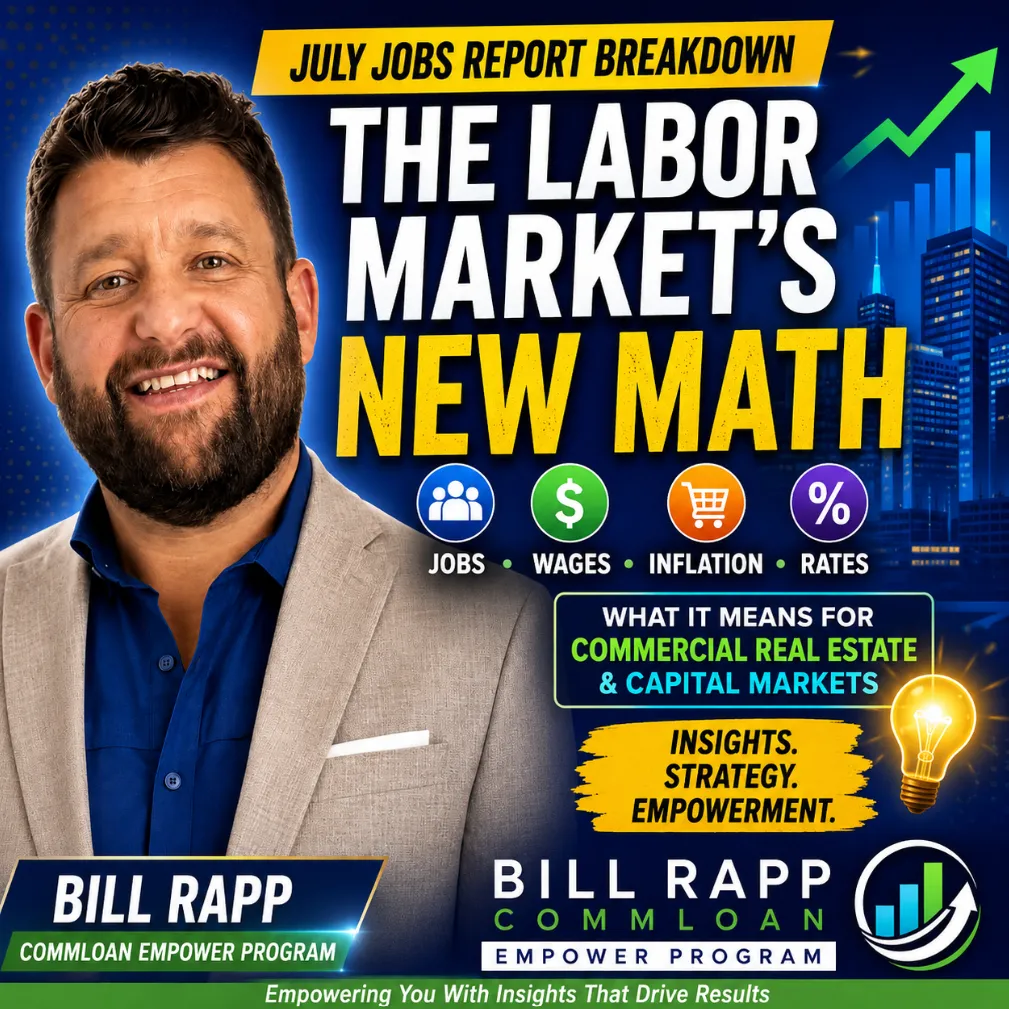
📉 The Labor Market’s New Math: What Slower Job Growth Means for CRE Investors 🏢
📉 The Labor Market’s New Math: What Slower Job Growth Means for CRE Investors 🏢
⚠️ Jobs, Wages & Interest Rates: Why the Labor Market Is Sending a New Signal 📊
A Labor Market Losing Momentum
The July 2026 employment report delivered a message that commercial real estate investors, business owners, and borrowers should not ignore: the U.S. labor market is slowing, but the numbers may require a different interpretation than they did just a few years ago.
Nonfarm payrolls declined by 23,000 jobs in July, compared with expectations for roughly 80,000 to 85,000 new jobs. Even more significant, May and June employment gains were revised downward by a combined 103,000 jobs.
At first glance, those numbers look decidedly negative. But underneath the headline is an important structural shift in the U.S. workforce—one that could influence economic growth, Federal Reserve policy, interest rates, consumer spending, and ultimately commercial real estate.
A Labor Market Losing Momentum
July's employment weakness was not isolated to a single industry.
Government employment declined substantially, particularly in local education. Retail and leisure and hospitality also recorded meaningful losses. Healthcare remained one of the comparatively stronger areas of the economy.
The combination of weak July hiring and significant downward revisions to previous months suggests that businesses have become increasingly cautious about expanding payrolls.
But that is only part of the story.
Why Did Unemployment Fall?
Despite the decline in payroll employment, the unemployment rate actually moved down to 4.1%.
Normally, falling unemployment would be interpreted as a sign of economic strength.
This time, however, labor-force dynamics played an important role. The labor-force participation rate fell to 61.4%, as people continued to leave the workforce.
That creates an unusual economic equation:
Fewer people looking for work can allow unemployment to remain relatively low even when employers aren't creating many jobs.
Demographics are increasingly important. Baby boomers continue moving into retirement, while reduced immigration has also constrained labor-force growth.
For investors and business owners, this means the headline unemployment rate may not tell the entire story.
The Labor Market's New Math
A shrinking workforce changes the number of jobs the economy needs to generate each month.
Historically, investors became accustomed to seeing payroll growth well above 100,000 jobs as an indication of a healthy economy.
That benchmark may no longer apply in the same way.
When labor-force growth slows, the economy requires fewer new jobs to keep unemployment stable. Consequently, an occasional negative payroll number does not automatically mean the economy is entering a severe recession.
Instead, investors need to evaluate employment alongside labor-force participation, wage growth, layoffs, job openings, consumer spending, and inflation.
Welcome to the “Low-Hire, Low-Fire” Economy
Perhaps the best description of today's labor market is low hire, low fire.
Businesses appear reluctant to expand payrolls aggressively, but they are not engaging in widespread layoffs either. Recent employment indicators continue to show relatively restrained layoffs even as hiring momentum weakens.
That creates an unusual environment.
Employees may be reluctant to leave existing positions because finding a new opportunity is becoming more difficult. Employers, meanwhile, may retain experienced workers because replacing them later could prove difficult.
The result is less labor-market churn.
For commercial real estate investors, this distinction matters enormously.
There is a major difference between an economy experiencing slower hiring and an economy experiencing widespread job destruction.
The first can produce slower growth.
The second can create significant pressure on occupancy, rents, credit quality, consumer spending, and property values.
Wage Growth Is Becoming the Next Big Story
Another important signal is wages.
Average hourly earnings growth slowed to approximately 3.2% year over year, its weakest pace since 2021. Meanwhile, recent inflation has been running above wage growth, creating pressure on real household purchasing power.
That relationship deserves close attention.
If prices rise faster than wages, consumers effectively become poorer in real terms—even if their nominal paycheck increases.
Eventually, that can affect discretionary spending.
And consumer spending matters enormously to commercial real estate.
Retail centers, restaurants, entertainment properties, hotels, self-storage facilities, apartments, and numerous other property sectors are directly or indirectly tied to household financial health.
The Federal Reserve's Complicated Decision
Normally, weakening employment and slower wage growth would strengthen the argument for easier monetary policy.
But the Federal Reserve faces a more complicated problem.
Inflation remains an important constraint. If supply disruptions, energy prices, tariffs, geopolitical events, or other factors keep inflation elevated, policymakers may have limited flexibility to respond aggressively to a weakening labor market.
That creates competing economic forces.
Slower employment growth argues for lower rates.
Persistent inflation argues for tighter monetary policy.
The Fed must determine which risk presents the greater threat.
For commercial real estate borrowers waiting for dramatically lower interest rates, that means patience may still be necessary.
What This Means for Commercial Real Estate
Commercial real estate investors should watch several channels through which the labor market can affect property performance.
Office: Slower white-collar hiring could reduce expansion demand and make tenants more conservative about space commitments.
Retail: Weak real wage growth can pressure discretionary consumer spending and tenant sales.
Industrial: Slower economic activity can affect transportation, warehousing, inventories, and distribution demand.
Multifamily: Employment remains fundamental to household formation, rent growth, and apartment affordability.
Hospitality: Consumer confidence, employment, corporate travel, and discretionary income can materially affect hotel performance.
Owner-Occupied CRE: Business owners may delay expansions, acquisitions, equipment purchases, or real estate investments when economic uncertainty rises.
But there is another side to the equation.
If slower economic growth eventually allows monetary policy to become less restrictive, commercial real estate financing conditions could improve.
That could help transaction activity, refinancing economics, debt-service coverage, and property valuations.
What CRE Borrowers Should Watch Next
One employment report does not establish a long-term trend.
The next several employment, inflation, wage, consumer-spending, and Federal Reserve reports will be especially important.
Commercial real estate investors should pay particular attention to the interaction between:
·Employment growth
·Labor-force participation
·Wage growth
·Inflation
·Consumer spending
·Treasury yields
·Federal Reserve policy
·Commercial mortgage rates
The critical question isn't simply whether employment is growing.
It is whether household income and economic activity can remain resilient while inflation moves toward a level that gives policymakers greater flexibility.
The Bottom Line
July's employment report does not necessarily signal an imminent employment collapse.
It does, however, reinforce the idea that the U.S. economy has entered a different labor-market environment.
Fewer workers + slower hiring + weaker wage growth = a new economic equation.
For commercial real estate investors and business owners, the implications extend well beyond the monthly jobs headline.
Employment influences consumer demand. Consumer demand influences business performance. Business performance influences property cash flow. And economic growth and inflation ultimately influence the cost and availability of capital.
That is why understanding the labor market isn't simply an economics exercise.
It's part of understanding commercial real estate risk.
The core July figures are consistent with current reporting: payrolls fell 23,000, May and June were revised down by 103,000 combined, unemployment declined to 4.1%, and participation fell to 61.4%.
Top of Form
Bottom of Form
Bill Rapp, CCIM
Director | CommLoan
📞 281-222-0433
📧 [email protected]
🌐 https://billrapp.commloan.com/
🌐 https://HoustonCommercialMortgage.com/
Commercial Real Estate Financing Nationwide
https://billrapp.commloan.com/
https://author.billrapponline.com/
https://www.amazon.com/dp/B0F32Z5BH2
https://veed.cello.so/FOmzTty6oi9
https://buymeacoffee.com/vikingente3
https://creplaybookseries.billrapponline.com
https://creplaybook.billrapponline.com/
©Bill Rapp, CCIM - Director - CommLoan

10 Tips for First-Time Homebuyers

Buying your first home can be both exciting and nerve-wracking at the same time. With so many things to consider and....
How To Choose the Right Lender for You

Lorem Ipsum is simply dummy text of the printing and typesetting industry. Lorem Ipsum has been the industry's standard dummy
Refinancing youe loan and when to do it

Lorem Ipsum is simply dummy text of the printing and typesetting industry. Lorem Ipsum has been the industry's standard dummy

Copyright ©2021 | Mortgage Viking Team
Licensed to Do Business | NMLS # 228246
This is not an offer to enter into an agreement. Not all customers will qualify. Information, rates and programs are subject to change without notice. All products are subject to credit and property approval. Other restrictions and limitations may apply. Copyright © 2021 | Medallion Funds
Corporate | NMLS ID NMLS # 1825831
Corporate Address : 2651 N. Green Valley Pkwy STE. 101 Henderson, NV 89014
Corporate NMLS NMLS # 1825831 | Company Website: https://medallionfunds.com/bill-rapp/
Copyright ©2021 | Mortgage Viking Team Licensed to Do Business | NMLS # 228246
This is not an offer to enter into an agreement. Not all customers will qualify. Information, rates and programs are subject to change without notice. All products are subject to credit and property approval. Other restrictions and limitations may apply
Corporate | NMLS ID NMLS # 1825831
Corporate Address : 2651 N. Green Valley Pkwy STE. 101 Henderson, NV 89014 https://medallionfunds.com/bill-rapp/
Facebook
Instagram
X
LinkedIn
Youtube
TikTok