

Low Rates.
Our rates are low, our application is quick and easy! We can get you clear to close in as little as 10 days!
Trusted By Agents With








Meet Bill Rapp
NMLS ID # NMLS # 228246
Bill Rapp, CCIM is a Houston-based Capital Advisor at Medallion Funds, specializing in commercial real estate finance and strategic lending solutions. With over two decades of experience across brokerage and capital markets, Bill has worked with leading firms including eXp Commercial, NEXA Mortgage, Viking Enterprise LLC, and Sun Realty Houston.
A graduate of Texas A&M University with a BBA in Finance, Bill brings a disciplined, underwriting-first approach to every deal. His expertise spans commercial and residential financing, including asset-based lending, FHA financing, reverse mortgages, REO properties, and investment strategies for both single-family and commercial assets.
Known for his focus on structure over rate, Bill helps investors, business owners, and developers navigate complex transactions with clarity, precision, and a long-term wealth-building mindset.


The Client Experience
Great experience purchasing our first home! Bill was easy to reach and always able to answer any questions or concerns.


Loan Programs Available





Blogs
The Top 5 Mortgage Mistakes to Avoid

Buying your first home can be both exciting and nerve-wracking at the same time. With so many things to consider and....
Mortgage Do and
Do not list

Mortgages can be tricky, and it's easy to make mistakes that can end up costing you dearly. That's why we've put together this list....
Tips On How To Improve Your Credit Score

Let's talk about some ways you can improve your credit score! Your credit score is actually a big deal, and it can affect...
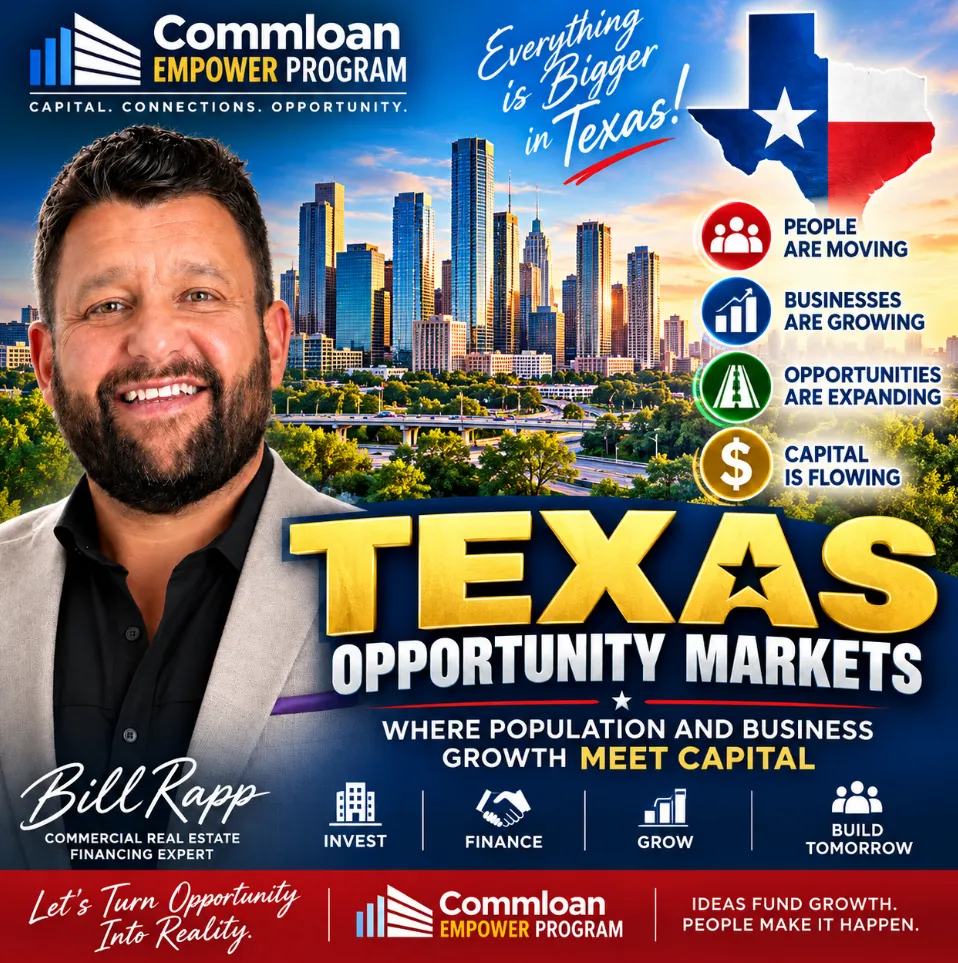
🚀 Texas Opportunity Markets: Where Population Growth, Business Expansion & Commercial Real Estate Capital Collide 🏢
🚀 Texas Opportunity Markets: Where Population Growth, Business Expansion & Commercial Real Estate Capital Collide 🏢
🤠 Investing in Texas Commercial Real Estate: Follow the Population, Jobs & Capital 📈
Texas Opportunity Markets: Where Population and Business Growth Meet Capital
Texas has long been associated with growth, but commercial real estate investors and business owners should look beyond the statewide headlines.
The bigger question is:
Where are population growth, business expansion, real estate development and available capital converging at the same time?
Those are the Texas opportunity markets worth watching.
For commercial real estate investors, developers and owner-users, population growth can create demand. Business expansion can create jobs and absorption. Infrastructure can unlock new development corridors. And capital determines whether an opportunity can actually become a transaction.
The strongest markets often sit at the intersection of all four.
Why Population Growth Matters to Commercial Real Estate
Population growth is one of the fundamental demand drivers behind commercial real estate.
More households can mean greater demand for:
·Retail and restaurants
·Medical offices
·Apartments
·Industrial and distribution facilities
·Professional services
·Schools and childcare
·Entertainment
·Self-storage
·Hotels
·Owner-occupied commercial buildings
But simply identifying a fast-growing city isn't enough.
Investors should ask where within that market the growth is occurring.
A metro area can grow rapidly while individual submarkets perform very differently. New highways, master-planned communities, employment centers and infrastructure improvements can redirect demand from one corridor to another.
That is why commercial real estate investing is ultimately a submarket business.
Houston: Scale, Diversification and Expanding Suburbs
Houston remains one of the most important commercial real estate markets in Texas because of its enormous economic scale and diversity.
Energy remains important, but Greater Houston also benefits from healthcare, manufacturing, logistics, petrochemicals, aerospace, construction and international trade.
For investors, some particularly interesting opportunities can emerge outside the urban core.
West Houston, Katy, Fulshear, Fort Bend County and other suburban growth corridors demonstrate an important Texas investment principle:
Follow the rooftops.
As residential development pushes outward, commercial development frequently follows.
New households need grocery stores, medical services, restaurants, childcare, professional offices, entertainment and neighborhood services.
For investors and developers, the opportunity may therefore appear before a corridor looks fully established.
Dallas-Fort Worth: Corporate and Industrial Growth at Scale
Dallas-Fort Worth combines population growth, corporate expansion, logistics infrastructure and a massive geographic footprint.
That creates opportunities across numerous commercial property types, including:
·Industrial
·Multifamily
·Retail
·Office
·Medical
·Mixed-use development
·Owner-occupied real estate
The Metroplex also illustrates why investors should analyze commercial real estate at the corridor and submarket level.
Different areas can have dramatically different construction pipelines, demographics, rents, vacancy and investment dynamics.
Austin and Central Texas: Growth Requires Discipline
Austin became one of America's most closely watched growth markets as technology companies, manufacturers and residents moved into Central Texas.
That growth created substantial commercial real estate development.
It also demonstrates an important lesson:
Economic growth does not automatically make every property a good investment.
When capital aggressively pursues growth, development can eventually outrun near-term demand.
Investors still need to evaluate supply pipelines, tenant demand, achievable rents, concessions, cap rates and financing assumptions.
A great market cannot rescue a poorly underwritten deal.
San Antonio: A Different Texas Growth Story
San Antonio offers investors another combination of population growth, military activity, healthcare, tourism, manufacturing and logistics.
It can also provide an interesting alternative for investors who want exposure to Texas growth without concentrating entirely on Dallas, Houston or Austin.
The broader lesson is diversification.
There isn't one "Texas commercial real estate market."
There are dozens of metropolitan areas, suburbs, corridors and specialized submarkets, each with its own supply-and-demand characteristics.
Secondary Texas Markets Deserve Attention
Investors should not overlook markets such as Fort Worth's outer growth corridors, Waco, Bryan-College Station, Temple-Belton, New Braunfels, Georgetown and other expanding Texas communities.
Some of tomorrow's opportunities may emerge where institutional capital has not yet fully arrived.
The challenge is separating sustainable economic growth from speculation.
Before investing, ask:
What is actually driving demand?
Population growth alone isn't sufficient.
Look for employment, infrastructure, household income, business formation, transportation improvements and tangible commercial absorption.
Business Growth Changes the Commercial Real Estate Equation
Population tells you where consumers are moving.
Business growth tells you where jobs and commercial demand may be moving.
When companies expand or relocate, the effects can spread across several property sectors.
A major employer may increase demand for industrial facilities, apartments, restaurants, medical services, retail, hotels and additional vendors.
That is why investors should study more than property-level financial statements.
Commercial real estate underwriting should include the economic ecosystem surrounding the property.
Infrastructure Can Create New Opportunity Corridors
Highways, interchanges, utilities and major public infrastructure can dramatically change a property's long-term potential.
In Texas, expanding transportation networks frequently open previously peripheral areas to development.
Investors should therefore monitor:
·Highway expansions
·New interchanges
·Utility extensions
·Major residential developments
·Industrial projects
·Corporate campuses
·Healthcare facilities
·Schools
·Municipal development plans
Commercial real estate opportunities can begin developing years before a corridor reaches maturity.
Then Comes Capital
Finding a growing market is only half the equation.
The investment still has to be financeable.
Commercial lenders evaluate transactions differently depending on the property, borrower, location and business plan.
Banks, credit unions, CMBS lenders, SBA lenders, agency lenders, debt funds, bridge lenders and private capital sources can all have different underwriting requirements.
Common considerations include:
Debt Service Coverage Ratio (DSCR) — Does the property's income adequately support the proposed debt?
Loan-to-Value (LTV) — How much leverage is being requested relative to the property's value?
Debt Yield — How much NOI does the property generate relative to the loan balance?
Borrower strength — What are the borrower's liquidity, net worth, credit profile and experience?
Property quality — How strong are occupancy, leases, tenants and operating history?
Market strength — Does the property's location support the lender's assumptions?
A property can be located in a booming Texas market and still fail lender underwriting.
Conversely, a properly structured transaction in an emerging submarket may attract multiple capital sources.
Capital Strategy Should Start Before the Purchase Contract
One of the biggest mistakes commercial buyers make is treating financing as something to solve after negotiating the property.
Instead, financing should be incorporated into acquisition strategy.
Before making an offer, understand:
1.How lenders are likely to calculate NOI.
2.What DSCR the property supports.
3.What LTV may be available.
4.Whether debt yield creates another constraint.
5.What equity contribution will likely be required.
6.Which lender category best fits the transaction.
This can prevent investors from negotiating a deal that doesn't work once lender underwriting begins.
Follow Growth—But Underwrite the Deal
Texas continues to create opportunities for commercial real estate investors, developers and business owners.
But growth alone isn't an investment strategy.
The better approach is to identify where several factors converge:
Population + Jobs + Infrastructure + Business Expansion + Real Estate Fundamentals + Capital
When those factors align, investors may find opportunities with stronger long-term demand drivers.
And when financing strategy is incorporated early, investors can evaluate not simply whether they want to buy a property—but whether the transaction can realistically be financed on terms that support the investment plan.
Looking for Commercial Real Estate Financing in Texas?
I'm Bill Rapp with the CommLoan Empower Program.
I help commercial real estate investors and business owners evaluate financing strategies and identify capital sources appropriate for their transactions.
Whether you're purchasing, refinancing, developing or repositioning commercial real estate, the objective isn't simply to find a lender.
It's to find the right capital structure for the deal.
If you're evaluating a Texas commercial real estate opportunity, let's discuss the property, underwriting and financing strategy before you get too far into the transaction.
I can also tighten this into a more locally focused Houston/Katy/West Texas growth-corridor version if you want the article to rank more heavily for your primary market.
Top of Form
Bottom of Form
Bill Rapp, CCIM
Director | CommLoan
📞 281-222-0433
📧 [email protected]
🌐 https://billrapp.commloan.com/
🌐 https://HoustonCommercialMortgage.com/
Commercial Real Estate Financing Nationwide
https://billrapp.commloan.com/
https://author.billrapponline.com/
https://www.amazon.com/dp/B0F32Z5BH2
https://veed.cello.so/FOmzTty6oi9
https://buymeacoffee.com/vikingente3
https://creplaybookseries.billrapponline.com
https://creplaybook.billrapponline.com/
©Bill Rapp, CCIM - Director - CommLoan

10 Tips for First-Time Homebuyers

Buying your first home can be both exciting and nerve-wracking at the same time. With so many things to consider and....
How To Choose the Right Lender for You

Lorem Ipsum is simply dummy text of the printing and typesetting industry. Lorem Ipsum has been the industry's standard dummy
Refinancing youe loan and when to do it

Lorem Ipsum is simply dummy text of the printing and typesetting industry. Lorem Ipsum has been the industry's standard dummy

Copyright ©2021 | Mortgage Viking Team
Licensed to Do Business | NMLS # 228246
This is not an offer to enter into an agreement. Not all customers will qualify. Information, rates and programs are subject to change without notice. All products are subject to credit and property approval. Other restrictions and limitations may apply. Copyright © 2021 | Medallion Funds
Corporate | NMLS ID NMLS # 1825831
Corporate Address : 2651 N. Green Valley Pkwy STE. 101 Henderson, NV 89014
Corporate NMLS NMLS # 1825831 | Company Website: https://medallionfunds.com/bill-rapp/
Copyright ©2021 | Mortgage Viking Team Licensed to Do Business | NMLS # 228246
This is not an offer to enter into an agreement. Not all customers will qualify. Information, rates and programs are subject to change without notice. All products are subject to credit and property approval. Other restrictions and limitations may apply
Corporate | NMLS ID NMLS # 1825831
Corporate Address : 2651 N. Green Valley Pkwy STE. 101 Henderson, NV 89014 https://medallionfunds.com/bill-rapp/
Facebook
Instagram
X
LinkedIn
Youtube
TikTok