

Low Rates.
Our rates are low, our application is quick and easy! We can get you clear to close in as little as 10 days!
Trusted By Agents With








Meet Bill Rapp
NMLS ID # NMLS # 228246
Bill Rapp, CCIM is a Houston-based Capital Advisor at Medallion Funds, specializing in commercial real estate finance and strategic lending solutions. With over two decades of experience across brokerage and capital markets, Bill has worked with leading firms including eXp Commercial, NEXA Mortgage, Viking Enterprise LLC, and Sun Realty Houston.
A graduate of Texas A&M University with a BBA in Finance, Bill brings a disciplined, underwriting-first approach to every deal. His expertise spans commercial and residential financing, including asset-based lending, FHA financing, reverse mortgages, REO properties, and investment strategies for both single-family and commercial assets.
Known for his focus on structure over rate, Bill helps investors, business owners, and developers navigate complex transactions with clarity, precision, and a long-term wealth-building mindset.


The Client Experience
Great experience purchasing our first home! Bill was easy to reach and always able to answer any questions or concerns.



Loan Programs Available




Blogs
The Top 5 Mortgage Mistakes to Avoid

Buying your first home can be both exciting and nerve-wracking at the same time. With so many things to consider and....
Mortgage Do and
Do not list

Mortgages can be tricky, and it's easy to make mistakes that can end up costing you dearly. That's why we've put together this list....
Tips On How To Improve Your Credit Score

Let's talk about some ways you can improve your credit score! Your credit score is actually a big deal, and it can affect...
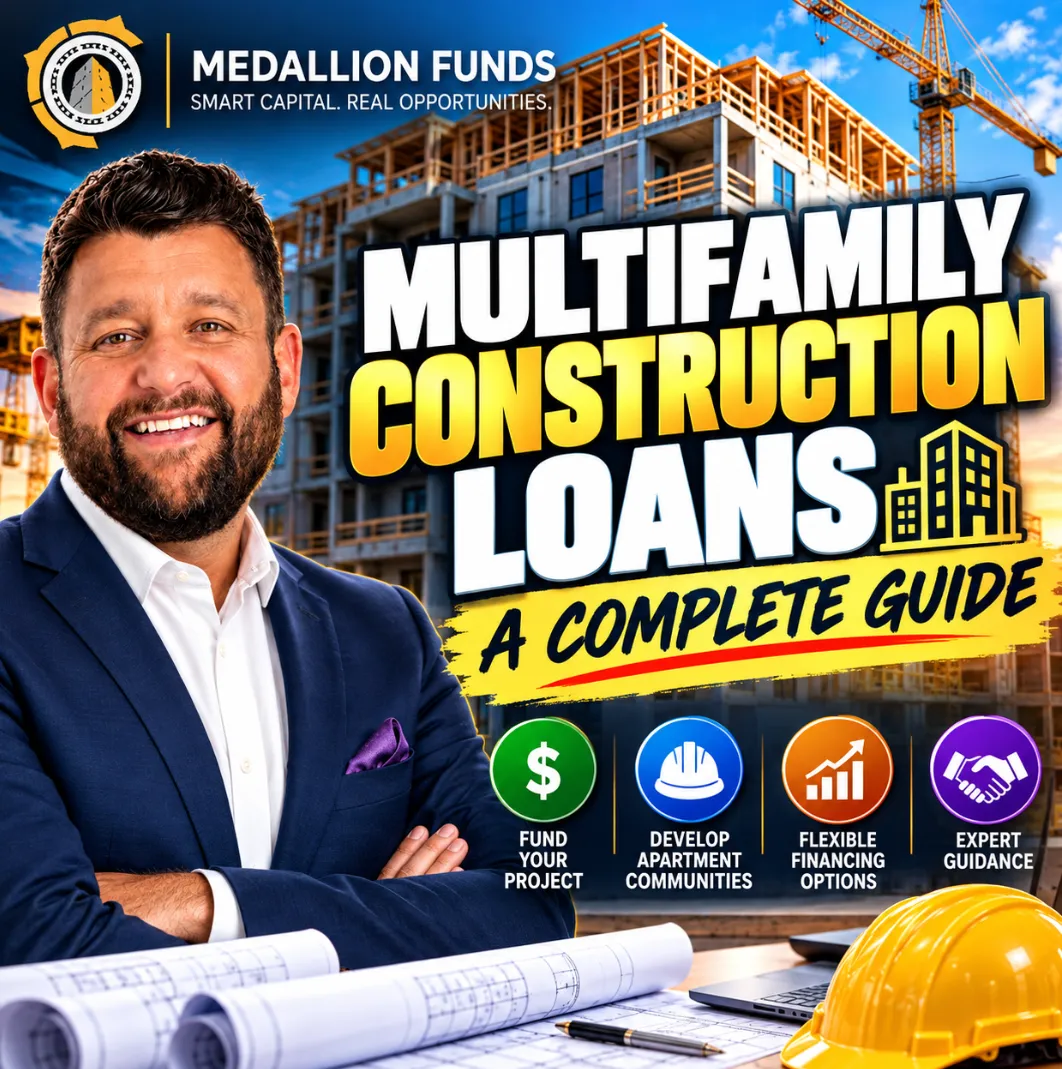
🏗️ Multifamily Construction Loans: The Complete Guide to Financing Apartment Developments 💰
🏗️ Multifamily Construction Loans: The Complete Guide to Financing Apartment Developments 💰
🏢 How to Finance Multifamily Construction: Loan Requirements, Down Payments & Lender Secrets 🔑
____________________________________________________________________________
🏗️ Multifamily Construction Loans: The Complete Guide to Financing Apartment Developments
Building a multifamily property can be an attractive way to create long-term wealth, generate rental income, and capitalize on housing demand. But before breaking ground on a duplex, townhome development, or large apartment community, you need to answer one critical question:
How are you going to finance the construction?
Multifamily construction loans are specifically designed to help developers and real estate investors finance ground-up residential projects. Unlike traditional mortgages, construction loans account for land acquisition, development costs, building expenses, construction schedules, and the eventual stabilization of rental income.
At Medallion Funds, we help investors, builders, and developers evaluate commercial real estate financing options and identify lenders suited to their projects.
This guide explains how multifamily construction loans work, typical qualification requirements, financing structures, common pitfalls, and how to prepare a project for lender review.
What Is a Multifamily Construction Loan?
A multifamily construction loan provides financing to develop residential properties containing multiple dwelling units.
These loans may support projects such as:
·Duplexes, triplexes, and fourplexes
·Townhome and build-to-rent communities
·Garden-style apartment developments
·Mid-rise and high-rise apartment buildings
·Mixed-use developments with residential components
·Affordable and workforce housing projects
The distinction between residential and commercial financing is important.
Properties containing one to four residential units may qualify for certain residential construction loan programs, depending on occupancy and lender guidelines.
Properties containing five or more units are generally financed through commercial multifamily construction lending programs.
The appropriate financing structure depends on the property, borrower, intended use, and development strategy.
How Do Multifamily Construction Loans Work?
Unlike a traditional mortgage that typically funds at closing, a construction loan generally releases proceeds in stages as construction progresses.
Step 1: Project Evaluation
The lender reviews the proposed development, including:
·Land acquisition and site control
·Zoning and development approvals
·Construction plans and specifications
·Project budget and cost estimates
·Developer experience
·Contractor qualifications
·Market demand and projected rental income
·Exit strategy
The lender may also require a feasibility study, appraisal, environmental assessment, and other third-party reports.
Step 2: Loan Approval and Closing
Once underwriting is completed and closing conditions are satisfied, the lender establishes the approved construction financing facility.
The borrower typically contributes required equity, subject to the lender's funding and disbursement requirements.
Step 3: Construction Draws
Rather than distributing all loan proceeds immediately, the lender releases funds through scheduled construction draws.
Draws are generally tied to completed work, verified costs, inspections, lien documentation, and remaining project budget.
Step 4: Construction Completion
When the project is completed, the developer obtains required occupancy approvals and begins or continues leasing the units.
Step 5: Permanent Financing or Sale
At the end of the construction loan term, the borrower generally must refinance, sell the property, or use an approved extension.
A successful exit requires more than simply completing construction. The project must also support the required permanent financing or sale proceeds.
Types of Multifamily Construction Loans
1. Conventional Bank Construction Loans
Banks and credit unions frequently finance experienced developers with strong financial profiles and well-supported projects.
These loans may offer competitive pricing but can involve significant documentation, sponsor liquidity requirements, guarantees, and underwriting scrutiny.
2. Private Lender and Debt Fund Construction Loans
Private lenders and debt funds may offer financing for projects that do not fit conventional bank requirements.
Potential advantages include flexible structures and faster decision-making, depending on the lender.
However, borrowers should carefully evaluate interest rates, origination fees, extension costs, recourse provisions, and exit requirements.
3. HUD Multifamily Construction Financing
The FHA-insured HUD Section 221(d)(4) program can support eligible new construction and substantial rehabilitation of multifamily rental housing.
Potential features include long-term, fixed-rate, fully amortizing financing, subject to program eligibility and approval.
HUD financing involves detailed underwriting, environmental and architectural reviews, construction requirements, and potentially lengthy processing.
It may be particularly relevant for qualified developers seeking long-term ownership rather than a short-term construction loan followed by refinancing.
4. Construction-to-Permanent Loans
Construction-to-permanent financing combines the construction phase with a predetermined path to long-term financing.
Depending on the lender, the arrangement may involve a single closing or a construction facility with a conditional permanent-loan conversion.
Borrowers should confirm conversion conditions, stabilization requirements, fees, and interest-rate provisions.
5. Bridge and Transitional Financing
Bridge financing may be useful for land acquisition, predevelopment work, or transitional situations before permanent construction financing is available.
However, not every bridge lender funds ground-up construction, and an acquisition bridge loan should not be mistaken for a complete development financing solution.
Multifamily Construction Loan Requirements
Every lender has its own underwriting criteria. The following are illustrative ranges and considerations, not guaranteed program terms.
Loan consideration | Illustrative guideline |
Loan-to-cost (LTC) | Often approximately 60%–75% |
Borrower equity | Often approximately 25%–40% of eligible project costs |
Loan term | Frequently 18–36 months for short-term construction facilities |
Interest structure | Often variable-rate, interest-only during construction |
Sponsor experience | Prior development experience strongly preferred |
Liquidity and reserves | Determined by project risk, lender, and guarantees |
Exit strategy | Refinance, sale, or approved conversion |
Some specialized programs may provide materially different leverage, maturities, or repayment structures.
Lenders typically evaluate three major factors.
The sponsor: Does the borrower have sufficient equity, liquidity, financial strength, and development experience?
The project: Are construction costs, rental projections, market assumptions, and contractor qualifications credible?
The exit: Can the property generate enough value and income to repay or refinance the construction loan?
Understanding Loan-to-Cost vs. Loan-to-Value
Two important financing measurements are loan-to-cost (LTC) and loan-to-value (LTV).
Loan-to-Cost
LTC compares the loan amount with the eligible total development cost.
LTC = Loan Amount ÷ Total Eligible Project Cost
For example, a $7.5 million construction loan on a $10 million project represents 75% LTC.
Loan-to-Value
LTV compares the loan amount with the property's appraised value.
LTV = Loan Amount ÷ Appraised Value
If that same property has a supported completed value of $12 million, the $7.5 million loan represents 62.5% LTV.
Many construction lenders evaluate both measurements and limit financing to the most restrictive applicable requirement.
Importantly, projected completed value is not the same as an appraiser-supported value or a guaranteed future sale price.
Real-World Example: Financing a 40-Unit Apartment Development
Consider a hypothetical developer planning a 40-unit apartment project.
Estimated Development Budget
Expense | Amount |
Land acquisition | $1,200,000 |
Hard construction costs | $6,000,000 |
Soft costs and professional fees | $1,100,000 |
Financing costs and interest reserve | $500,000 |
Contingency and other development costs | $1,200,000 |
Total project cost | $10,000,000 |
Assume a lender offers 70% loan-to-cost financing.
Construction loan: $7,000,000
Required project equity: $3,000,000
If the lender also requires a maximum 65% LTV based on completed value, the completed appraisal would need to support at least approximately $10.77 million for the entire $7 million loan to satisfy that constraint.
What Happens After Construction?
Assume the completed property achieves:
·40 rental units
·Average monthly rent of $2,000 per unit
·5% economic vacancy and credit loss
·Operating expenses equal to 40% of effective gross income
Annual potential rental income:
40 × $2,000 × 12 = $960,000
After the assumed 5% economic vacancy and credit loss:
Effective gross income: $912,000
After operating expenses of $364,800:
Estimated net operating income: $547,200
At an illustrative 5.5% capitalization rate:
Estimated stabilized value: approximately $9.95 million
This example reveals a critical development financing lesson.
Although the developer spent $10 million, the property's income-based stabilized value is only approximately $9.95 million under these assumptions.
At a 65% permanent-loan LTV limit, potential financing would be approximately $6.47 million before considering debt-service coverage, loan costs, or other constraints.
That is less than the original $7 million construction loan.
The developer could face a refinancing shortfall of approximately $530,000, even though construction was completed successfully.
This is why realistic rental assumptions, development costs, capitalization rates, and permanent financing projections matter before construction begins.
All figures are hypothetical and exclude certain potential income and expense adjustments. Actual underwriting may produce different results.
What Interest Rates Apply to Multifamily Construction Loans?
Construction loan interest rates vary based on market conditions, lender type, borrower strength, project location, leverage, and the development's risk profile.
Common structures include:
Floating-rate loans: Pricing may be tied to a benchmark such as SOFR plus a lender spread.
Fixed-rate construction loans: Some lenders offer fixed pricing for a defined period.
Interest-only payments: Many short-term construction loans require interest payments during construction, often based on outstanding funded balances.
Capitalized interest: Certain lenders permit an interest reserve to fund eligible interest costs during construction, subject to the approved budget.
The lowest advertised rate is not necessarily the lowest-cost financing option.
Borrowers should compare origination fees, extension charges, unused-funds provisions, rate caps, legal expenses, guarantees, and prepayment terms.
Seven Mistakes to Avoid When Financing Multifamily Construction
1. Underestimating Construction Costs
Material costs, labor shortages, utility work, and unforeseen site conditions can create substantial budget overruns.
2. Ignoring Contingency Requirements
A realistic contingency can protect against unforeseen costs and help satisfy lender requirements.
3. Overestimating Rental Income
Aggressive rent projections can make a project appear financially attractive while masking significant downside risk.
4. Failing to Evaluate the Exit Strategy
Developers should model permanent loan proceeds using realistic NOI, debt-service coverage, interest rates, and valuation assumptions.
5. Overlooking Interest Carry
Construction delays can increase financing costs and exhaust an insufficient interest reserve.
6. Choosing Financing Based Only on Interest Rate
The complete financing structure matters, including draw procedures, recourse, extension rights, fees, and closing certainty.
7. Waiting Too Long to Arrange Financing
Financing discussions should begin during the feasibility and predevelopment stages, not immediately before the anticipated groundbreaking date.
Documents Needed for a Multifamily Construction Loan
To prepare for a lender discussion, developers should assemble:
·Executive project summary
·Sponsor biography and development track record
·Land purchase agreement or proof of ownership
·Site plan and architectural drawings
·Zoning and entitlement information
·Detailed sources-and-uses budget
·Construction schedule
·General contractor qualifications and construction contract
·Market study and rental comparables
·Development pro forma and stabilization forecast
·Sponsor financial statements and liquidity verification
·Proposed permanent financing or sale strategy
The more complete and consistent the package, the easier it is for a lender to evaluate the project.
Why Work With a Commercial Mortgage Broker?
Multifamily construction financing is highly specialized.
Different lenders may focus on different geographic markets, property sizes, loan amounts, development stages, and borrower experience levels.
Working with an experienced commercial mortgage broker can help borrowers evaluate available financing structures, understand lender requirements, and identify potential obstacles before submitting a full application.
At Medallion Funds, our objective is to help developers and investors make informed financing decisions based on the economics of the project, not simply the advertised loan rate.
We can assist with evaluating construction financing, bridge financing, HUD multifamily financing, and potential permanent loan strategies, subject to lender and program availability.
Frequently Asked Questions
Can I get a multifamily construction loan with no development experience?
It may be possible, but financing can be more challenging. Some lenders may consider a borrower who partners with an experienced developer or general contractor and meets additional equity or guarantee requirements.
How much down payment is required?
Many conventional commercial construction scenarios require approximately 25%–40% project equity, but the amount varies significantly by lender, project, land equity, and financing program.
Can land equity count toward my down payment?
Sometimes. Lenders may recognize eligible contributed land equity, subject to valuation, existing liens, acquisition history, and underwriting policies.
Do multifamily construction loans require personal guarantees?
Many bank and private construction loans involve some form of sponsor recourse or completion guarantees. The exact obligations vary, and some specialized programs may provide nonrecourse structures with customary carve-outs.
How long does it take to get a multifamily construction loan?
Timelines vary considerably. Straightforward private financing may close faster than conventional bank or HUD-insured financing, while incomplete approvals, entitlements, environmental reviews, and construction documentation can delay any transaction.
Can I refinance once the apartment building is complete?
Potentially, yes. The property must satisfy the permanent lender's requirements for value, income, occupancy, debt-service coverage, and other underwriting conditions.
Final Thoughts: Finance the Project Before You Build It
Multifamily development can create significant investment opportunities, but the financing strategy must support the project from land acquisition through construction, lease-up, and stabilization.
The most important question is not simply how much a lender will advance.
It is whether the development can be completed, stabilized, and refinanced or sold under realistic market conditions.
Ready to Explore Multifamily Construction Financing?
I'm Bill Rapp Jr., CCIM, Director of Capital Advisory with Medallion Funds.
If you're planning an apartment development, build-to-rent community, or other multifamily construction project, let's discuss your development budget, equity requirements, financing options, and exit strategy.
Bill Rapp
Partner & Director of Capital Advisory | Medallion Funds
Commercial Lending Nationwide
Residential Lending in AL, CA, CO, NV & TXBottom of Form
https://www.billrapponline.com/
https://findamortgagebroker.com/Profile/WilliamRappJr28883
https://billrapp.commloan.com/
https://billrapponline.com/financingfuturescre-houston-katy
https://houstoncommercialmortgage.com/
https://author.billrapponline.com
https://doctorvideo.billrapponline.com/
https://veteransvideo.billrapponline.com/
https://mortgageviking.billrapponline.com/
https://fha203h.billrapponline.com/
https://renovationvideo.billrapponline.com
https://medallionfunds.com/bill-rapp/
https://www.amazon.com/dp/B0F32Z5BH2
https://veed.cello.so/FOmzTty6oi9
https://buymeacoffee.com/vikingente3
https://creplaybookseries.billrapponline.com
https://creplaybook.billrapponline.com/
© Bill Rapp, Medallion Funds LLC, Director of Capital Advisory

10 Tips for First-Time Homebuyers

Buying your first home can be both exciting and nerve-wracking at the same time. With so many things to consider and....
How To Choose the Right Lender for You

Lorem Ipsum is simply dummy text of the printing and typesetting industry. Lorem Ipsum has been the industry's standard dummy
Refinancing youe loan and when to do it

Lorem Ipsum is simply dummy text of the printing and typesetting industry. Lorem Ipsum has been the industry's standard dummy
Copyright ©2021 | Mortgage Viking Team
Licensed to Do Business | NMLS # 228246
This is not an offer to enter into an agreement. Not all customers will qualify. Information, rates and programs are subject to change without notice. All products are subject to credit and property approval. Other restrictions and limitations may apply. Copyright © 2021 | Medallion Funds
Corporate | NMLS ID NMLS # 1825831
Corporate Address : 2651 N. Green Valley Pkwy STE. 101 Henderson, NV 89014
Corporate NMLS NMLS # 1825831 | Company Website: https://medallionfunds.com/bill-rapp/
Copyright ©2021 | Mortgage Viking Team Licensed to Do Business | NMLS # 228246
This is not an offer to enter into an agreement. Not all customers will qualify. Information, rates and programs are subject to change without notice. All products are subject to credit and property approval. Other restrictions and limitations may apply
Corporate | NMLS ID NMLS # 1825831
Corporate Address : 2651 N. Green Valley Pkwy STE. 101 Henderson, NV 89014 https://medallionfunds.com/bill-rapp/
Facebook
Instagram
X
LinkedIn
Youtube
TikTok