

Low Rates.
Our rates are low, our application is quick and easy! We can get you clear to close in as little as 10 days!
Trusted By Agents With








Meet Bill Rapp
NMLS ID # NMLS # 228246
Bill Rapp, CCIM is a Houston-based Capital Advisor at Medallion Funds, specializing in commercial real estate finance and strategic lending solutions. With over two decades of experience across brokerage and capital markets, Bill has worked with leading firms including eXp Commercial, NEXA Mortgage, Viking Enterprise LLC, and Sun Realty Houston.
A graduate of Texas A&M University with a BBA in Finance, Bill brings a disciplined, underwriting-first approach to every deal. His expertise spans commercial and residential financing, including asset-based lending, FHA financing, reverse mortgages, REO properties, and investment strategies for both single-family and commercial assets.
Known for his focus on structure over rate, Bill helps investors, business owners, and developers navigate complex transactions with clarity, precision, and a long-term wealth-building mindset.


The Client Experience
Great experience purchasing our first home! Bill was easy to reach and always able to answer any questions or concerns.


Loan Programs Available





Blogs
The Top 5 Mortgage Mistakes to Avoid

Buying your first home can be both exciting and nerve-wracking at the same time. With so many things to consider and....
Mortgage Do and
Do not list

Mortgages can be tricky, and it's easy to make mistakes that can end up costing you dearly. That's why we've put together this list....
Tips On How To Improve Your Credit Score

Let's talk about some ways you can improve your credit score! Your credit score is actually a big deal, and it can affect...
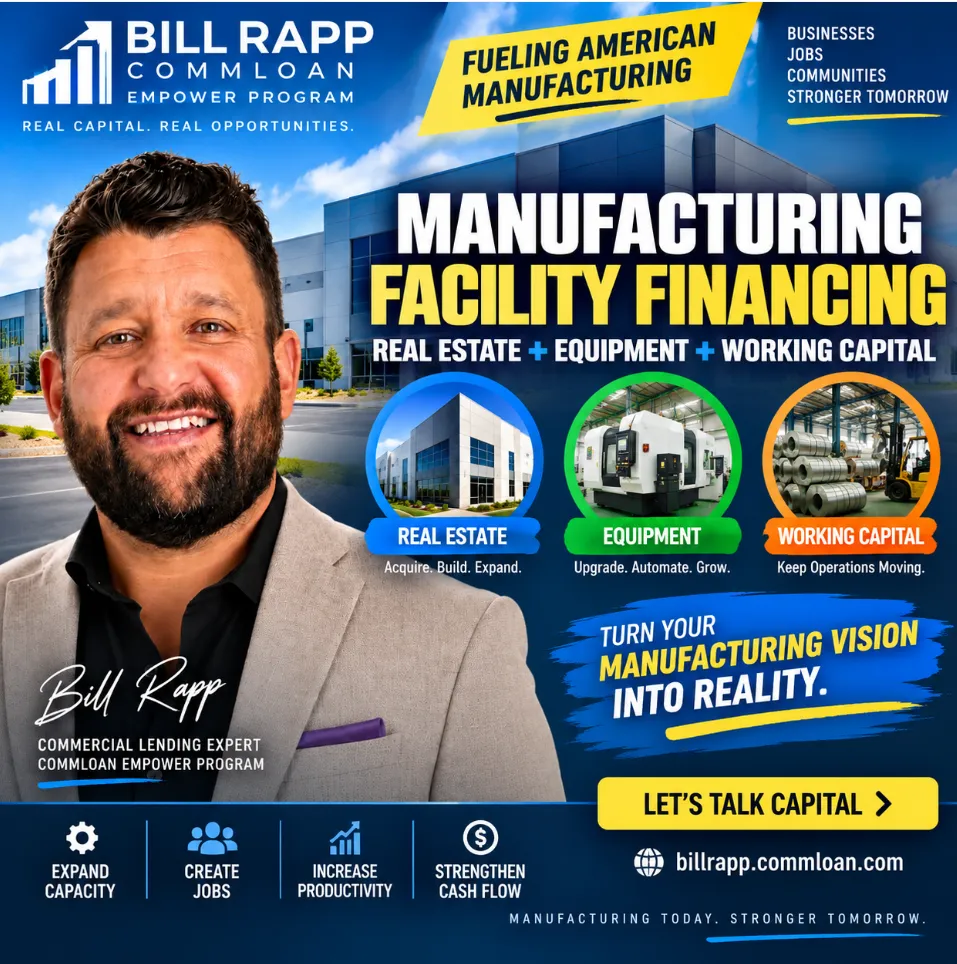
🏭 Manufacturing Facility Financing: How to Fund Real Estate, Equipment & Working Capital 💰
🏭 Manufacturing Facility Financing: How to Fund Real Estate, Equipment & Working Capital 💰
💵 Financing a Manufacturing Business: One Capital Strategy for Property, Equipment & Growth 🏭
Manufacturing Facility Financing: Real Estate + Equipment + Working Capital
Buying or expanding a manufacturing facility is rarely just a commercial real estate transaction.
A manufacturer may need to purchase the building, install production equipment, make facility improvements, finance inventory, hire employees, and maintain enough working capital to keep the operation running while production ramps up.
That means the financing strategy should look beyond the real estate.
For manufacturers, the better question isn't simply:
“How much can I borrow against the building?”
It is:
“How do we structure the capital needed to make the entire project work?”
That's where comprehensive manufacturing facility financing becomes important.
Manufacturing Financing Is More Than a Commercial Mortgage
Consider a manufacturer buying a larger facility to increase production.
The real estate might cost $4 million. But the total project could also require:
·$1 million of manufacturing equipment
·$500,000 of renovations and electrical upgrades
·$300,000 for installation and relocation
·$500,000 of additional inventory
·$700,000 of working capital
What initially appears to be a $4 million commercial real estate purchase may actually represent a $7 million capital requirement.
If financing is structured only around the property acquisition, the company could close on the building and immediately find itself short of the capital necessary to operate efficiently.
The capital structure should therefore be evaluated alongside the real estate.
1. Financing the Manufacturing Facility
The real estate component is usually the foundation of the transaction.
Manufacturers may need financing to:
·Purchase an existing manufacturing facility
·Construct a new plant
·Expand an existing building
·Acquire a warehouse with manufacturing capabilities
·Refinance an existing facility
·Consolidate facilities
·Finance renovations or improvements
The lender will generally evaluate both the real estate collateral and the operating company.
For owner-occupied properties, the analysis can be substantially different from underwriting an investor-owned commercial property. Rather than relying primarily on rent and property-level NOI, lenders may analyze the operating company's historical and projected cash flow.
2. Manufacturing Equipment Financing
The building may only be part of the investment.
Manufacturers frequently require substantial equipment, including CNC machines, production lines, robotics, fabrication equipment, packaging systems, forklifts, compressors, specialized machinery, and automation technology.
Equipment financing can potentially be incorporated into a broader financing strategy or structured separately.
Important questions include:
What equipment is being purchased?
Lenders need to understand its cost, useful life, installation requirements and resale market.
Is the equipment new or used?
Equipment age and condition can influence financing terms.
Is the equipment permanently installed?
Some machinery effectively becomes part of the facility, while other equipment remains movable collateral.
How quickly will the equipment generate revenue?
The ramp-up period matters because debt service may begin before the equipment reaches full production capacity.
3. Working Capital Can Make or Break the Expansion
Working capital is often overlooked when companies plan facility acquisitions.
A growing manufacturer may suddenly need additional cash for:
·Raw materials
·Inventory
·Payroll
·New employees
·Training
·Utilities
·Transportation
·Marketing
·Vendor deposits
·Accounts receivable
·Unexpected operating expenses
Growth consumes cash.
A company can be profitable on paper and still experience a liquidity squeeze when revenue expands rapidly.
That is why the capital plan should consider working capital requirements before the transaction closes, rather than attempting to solve a liquidity problem afterward.
4. SBA Financing for Manufacturing Companies
For qualifying owner-occupied businesses, SBA 7(a) and SBA 504 financing can be important options to evaluate.
Depending on the transaction and eligibility requirements, SBA financing may help manufacturers finance combinations of real estate, equipment, improvements and certain project costs.
The two programs serve different purposes.
SBA 504 financing is primarily designed around major fixed assets such as owner-occupied commercial real estate and long-term equipment.
SBA 7(a) financing can offer greater flexibility for transactions involving business acquisition costs, equipment and working capital in addition to real estate.
The appropriate structure depends on the borrower's objectives, project costs, collateral, cash flow, ownership structure and SBA eligibility.
5. Conventional Bank Financing
Strong manufacturing companies may also qualify for conventional bank financing.
A bank could potentially structure several facilities around the business, such as a commercial mortgage, equipment term loan and revolving line of credit.
This can be particularly useful when the borrower wants separate financing instruments matched to the useful life of different assets.
Long-lived real estate might receive longer-term amortization, while equipment could receive a shorter term and working capital could be supported through a revolving facility.
This concept is often referred to as matching the financing to the asset.
6. What Lenders Evaluate
Manufacturing loans require lenders to understand more than the property.
Underwriting may include analysis of:
Historical cash flow: Can the company support existing and proposed debt?
Revenue trends: Is the business growing, stable or declining?
Customer concentration: How dependent is the manufacturer on one or two major customers?
Industry exposure: How cyclical or specialized is the company's market?
Equipment: What is the value and marketability of the machinery?
Management experience: Does the ownership team have a demonstrated history of operating the business successfully?
Liquidity: How much cash remains after the transaction closes?
Leverage: How much debt will the company carry relative to its earnings and assets?
Collateral: What real estate, equipment and other assets support the financing?
The lender is ultimately evaluating the ability of the operating company to generate sufficient cash flow to repay the debt.
7. Don't Use All Your Cash to Buy the Building
One of the most important strategic considerations is liquidity.
Suppose a manufacturer has $2 million available for an expansion.
Using nearly all of that money as the down payment on the real estate might reduce the mortgage—but it could leave the company without sufficient cash for equipment, inventory, payroll and unexpected expenses.
A better financing analysis considers the company's post-closing liquidity.
The objective isn't necessarily to minimize debt.
The objective is to create a capital structure the business can reasonably support while preserving enough liquidity to operate and grow.
8. Build the Capital Stack Before Negotiating the Property
Manufacturers considering a facility acquisition should begin the financing conversation early.
Before signing a purchase agreement, model the entire project:
**Real estate acquisition
·renovations
·equipment
·installation
·inventory
·closing costs
·working capital
= total project cost**
Then determine which financing sources could appropriately support each component.
This provides a much clearer picture of the company's actual equity requirement.
It can also prevent a common mistake: negotiating a property purchase first and trying to solve the financing structure afterward.
Manufacturing Growth Requires a Capital Strategy
Manufacturing expansion is fundamentally a capital allocation decision.
The right facility can provide room to increase production. New equipment can improve efficiency. Additional working capital can support larger orders and additional employees.
But those investments need to work together.
A well-structured manufacturing financing strategy considers the real estate, equipment and operating capital as interconnected components of the same growth plan.
At CommLoan, we help commercial borrowers evaluate financing alternatives and identify capital structures appropriate for their transaction.
If you're purchasing, expanding or refinancing a manufacturing facility, start with the entire capital requirement—not simply the price of the building.
Top of Form
Bottom of Form
Bill Rapp, CCIM
Director | CommLoan
📞 281-222-0433
📧 [email protected]
🌐 https://billrapp.commloan.com/
🌐 https://HoustonCommercialMortgage.com/
Commercial Real Estate Financing Nationwide
https://billrapp.commloan.com/
https://author.billrapponline.com/
https://www.amazon.com/dp/B0F32Z5BH2
https://veed.cello.so/FOmzTty6oi9
https://buymeacoffee.com/vikingente3
https://creplaybookseries.billrapponline.com
https://creplaybook.billrapponline.com/
©Bill Rapp, CCIM - Director - CommLoan

10 Tips for First-Time Homebuyers

Buying your first home can be both exciting and nerve-wracking at the same time. With so many things to consider and....
How To Choose the Right Lender for You

Lorem Ipsum is simply dummy text of the printing and typesetting industry. Lorem Ipsum has been the industry's standard dummy
Refinancing youe loan and when to do it

Lorem Ipsum is simply dummy text of the printing and typesetting industry. Lorem Ipsum has been the industry's standard dummy

Copyright ©2021 | Mortgage Viking Team
Licensed to Do Business | NMLS # 228246
This is not an offer to enter into an agreement. Not all customers will qualify. Information, rates and programs are subject to change without notice. All products are subject to credit and property approval. Other restrictions and limitations may apply. Copyright © 2021 | Medallion Funds
Corporate | NMLS ID NMLS # 1825831
Corporate Address : 2651 N. Green Valley Pkwy STE. 101 Henderson, NV 89014
Corporate NMLS NMLS # 1825831 | Company Website: https://medallionfunds.com/bill-rapp/
Copyright ©2021 | Mortgage Viking Team Licensed to Do Business | NMLS # 228246
This is not an offer to enter into an agreement. Not all customers will qualify. Information, rates and programs are subject to change without notice. All products are subject to credit and property approval. Other restrictions and limitations may apply
Corporate | NMLS ID NMLS # 1825831
Corporate Address : 2651 N. Green Valley Pkwy STE. 101 Henderson, NV 89014 https://medallionfunds.com/bill-rapp/
Facebook
Instagram
X
LinkedIn
Youtube
TikTok