

Low Rates.
Our rates are low, our application is quick and easy! We can get you clear to close in as little as 10 days!
Trusted By Agents With








Meet Bill Rapp
NMLS ID # NMLS # 228246
Bill Rapp, CCIM is a Houston-based Capital Advisor at Medallion Funds, specializing in commercial real estate finance and strategic lending solutions. With over two decades of experience across brokerage and capital markets, Bill has worked with leading firms including eXp Commercial, NEXA Mortgage, Viking Enterprise LLC, and Sun Realty Houston.
A graduate of Texas A&M University with a BBA in Finance, Bill brings a disciplined, underwriting-first approach to every deal. His expertise spans commercial and residential financing, including asset-based lending, FHA financing, reverse mortgages, REO properties, and investment strategies for both single-family and commercial assets.
Known for his focus on structure over rate, Bill helps investors, business owners, and developers navigate complex transactions with clarity, precision, and a long-term wealth-building mindset.


The Client Experience
Great experience purchasing our first home! Bill was easy to reach and always able to answer any questions or concerns.


Loan Programs Available





Blogs
The Top 5 Mortgage Mistakes to Avoid

Buying your first home can be both exciting and nerve-wracking at the same time. With so many things to consider and....
Mortgage Do and
Do not list

Mortgages can be tricky, and it's easy to make mistakes that can end up costing you dearly. That's why we've put together this list....
Tips On How To Improve Your Credit Score

Let's talk about some ways you can improve your credit score! Your credit score is actually a big deal, and it can affect...
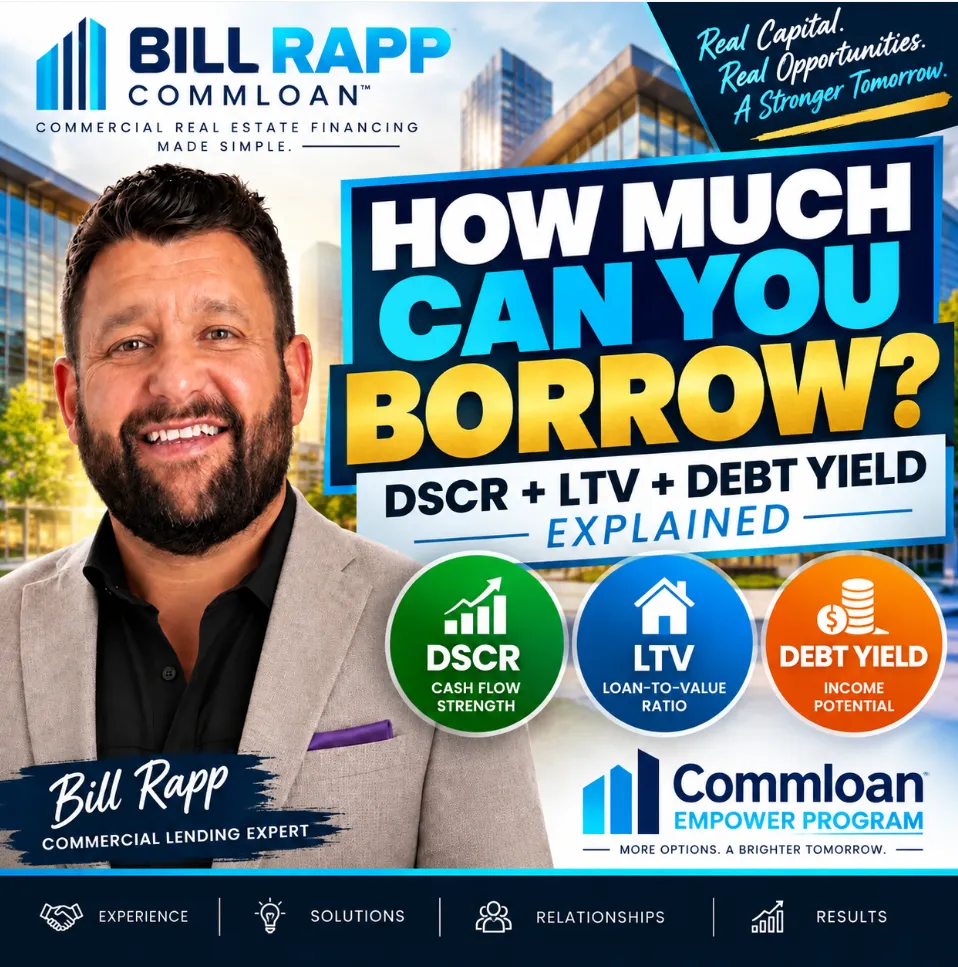
🏢 How Much Can You Borrow on Commercial Real Estate? DSCR, LTV & Debt Yield Explained 💰
🏢 How Much Can You Borrow on Commercial Real Estate? DSCR, LTV & Debt Yield Explained 💰
📊 Commercial Real Estate Loan Sizing: How DSCR, LTV & Debt Yield Determine Your Maximum Loan 🏦
How Much Can You Borrow? DSCR + LTV + Debt Yield Explained
How Much Can You Borrow? DSCR + LTV + Debt Yield Explained
When commercial real estate investors ask, “How much can I borrow?”, there usually isn't one simple answer.
Unlike many residential mortgages, where borrower income and debt-to-income ratios play a major role, commercial real estate lenders often focus heavily on the economics of the property itself.
Three calculations frequently determine how much financing a commercial property can support:
DSCR — Debt Service Coverage Ratio
LTV — Loan-to-Value Ratio
Debt Yield
Understanding these three commercial real estate lending metrics can help you estimate loan proceeds before approaching a lender—and understand why the loan amount a lender offers may be lower than you expected.
What Determines How Much You Can Borrow on Commercial Real Estate?
Commercial lenders typically evaluate several factors, including:
·Property net operating income
·Property value
·Requested loan amount
·Annual debt service
·Interest rate
·Amortization period
·Property type
·Occupancy and tenant quality
·Lease rollover
·Borrower liquidity and net worth
·Sponsor experience
·Market conditions
But DSCR, LTV and debt yield are three of the most important measurements used to size many commercial real estate loans.
The important point is this:
The maximum loan isn't necessarily determined by the metric that looks best. It can be determined by whichever underwriting constraint produces the lowest acceptable loan amount.
Let's examine each one.
1. What Is DSCR?
Debt Service Coverage Ratio (DSCR) measures a property's ability to generate enough net operating income to cover its required loan payments.
The basic formula is:
DSCR = Net Operating Income ÷ Annual Debt Service
Suppose an investment property produces $150,000 of annual NOI and the proposed mortgage requires $120,000 of annual principal and interest payments.
The DSCR would be:
$150,000 ÷ $120,000 = 1.25x DSCR
A 1.25x DSCR means the property generates $1.25 of NOI for every $1.00 of annual debt service.
Why DSCR Matters
Lenders want a cushion between property income and required debt payments.
A property operating at exactly 1.00x DSCR would theoretically generate only enough NOI to make its debt payments, leaving no underwriting cushion if revenue declines or expenses increase.
Required DSCR varies by lender, property type, transaction and market conditions.
That's why borrowers should never assume that one DSCR requirement applies to every commercial loan.
How Interest Rates Affect DSCR Loan Proceeds
DSCR also explains why rising interest rates can reduce borrowing capacity even when a property's NOI hasn't changed.
Consider a property generating the same $150,000 NOI.
If a lender requires a 1.25x DSCR, maximum annual debt service would be:
$150,000 ÷ 1.25 = $120,000
The loan amount supported by that $120,000 payment depends on the interest rate and amortization schedule.
Higher rates generally mean the same annual debt-service allowance supports less principal.
This is one reason commercial real estate investors can encounter a refinancing gap at maturity.
The property's income may still be healthy, but today's interest rate may not support the outstanding loan balance under the lender's DSCR requirement.
2. What Is LTV?
Loan-to-Value Ratio (LTV) compares the loan amount with the lender's accepted property value.
The formula is:
LTV = Loan Amount ÷ Property Value
For example, assume a property is valued at $2,000,000 and the requested loan is $1,400,000.
The LTV is:
$1,400,000 ÷ $2,000,000 = 70% LTV
From another perspective, if a lender permits a maximum 70% LTV on a $2 million property, the leverage-based maximum would be:
$2,000,000 × 70% = $1,400,000
Simple enough—but there is an important catch.
LTV Does Not Guarantee the Loan Amount
Borrowers sometimes make the mistake of assuming:
“The lender offers 75% LTV, so I can borrow 75% of the property's value.”
Not necessarily.
The loan still has to satisfy the lender's other underwriting requirements.
Imagine a $2 million property with a 75% maximum LTV.
That would theoretically allow:
$2,000,000 × 75% = $1,500,000
But what if the property's NOI only supports a $1.25 million loan under the lender's DSCR requirement?
The borrower may be limited to approximately $1.25 million despite the higher LTV threshold.
Maximum LTV is a ceiling—not a promise of proceeds.
3. What Is Debt Yield?
Debt yield measures the property's NOI relative to the loan amount.
The formula is:
Debt Yield = NOI ÷ Loan Amount
Suppose a property generates $150,000 of NOI and the requested commercial mortgage is $1,500,000.
Debt yield would be:
$150,000 ÷ $1,500,000 = 10%
Debt yield gives lenders another way to evaluate leverage and risk.
Unlike DSCR, debt yield is not directly dependent on the interest rate or amortization period.
That makes it useful as a relatively straightforward measure of how much property income exists relative to the lender's principal exposure.
Reverse the Debt Yield Formula to Estimate Loan Proceeds
Debt yield can also be used to estimate maximum loan proceeds.
Assume:
NOI = $150,000
Required Debt Yield = 10%
Then:
Maximum Loan = NOI ÷ Required Debt Yield
$150,000 ÷ 10% = $1,500,000
If the lender instead required a 12% debt yield:
$150,000 ÷ 12% = $1,250,000
Same property. Same NOI.
But the more conservative debt-yield requirement reduces potential proceeds by $250,000.
DSCR vs. LTV vs. Debt Yield: Which One Determines Your Loan Amount?
Potentially all three.
Consider this simplified example.
A commercial investor owns a property valued at $3 million with $210,000 in annual NOI.
After applying its underwriting requirements, suppose a lender determines:
LTV allows: $2,100,000
DSCR supports: $1,850,000
Debt yield supports: $1,750,000
Which loan amount matters?
The debt-yield constraint is the most restrictive in this simplified scenario.
That means a borrower expecting approximately $2.1 million based solely on LTV could be surprised when the lender's underwriting produces substantially lower proceeds.
This is why sophisticated commercial financing analysis should evaluate multiple constraints before a borrower starts negotiating a transaction.
Why NOI Is So Important
Notice that both DSCR and debt yield depend directly on Net Operating Income.
That makes accurate NOI underwriting critical.
Commercial lenders may examine:
·Historical operating statements
·Trailing-12-month financials
·Current rent rolls
·Existing leases
·Contractual rent
·Vacancy
·Concessions
·Property taxes
·Insurance
·Repairs and maintenance
·Management expenses
·Replacement reserves
·Nonrecurring income and expenses
The borrower's stated NOI and the lender's underwritten NOI aren't always identical.
A lender may adjust revenue or expenses when determining sustainable cash flow.
A seemingly small NOI adjustment can materially change borrowing capacity.
Why Commercial Loan Quotes Can Vary Between Lenders
Another important point for investors and business owners is that different lenders can analyze the same transaction differently.
A bank, credit union, CMBS lender, debt fund or other capital source may have different requirements for:
·Minimum DSCR
·Maximum LTV
·Minimum debt yield
·Amortization
·Recourse
·Liquidity
·Net worth
·Property type
·Occupancy
·Loan size
·Sponsor experience
·Geographic concentration
This means the question isn't simply:
“Can I get a commercial loan?”
A better question is:
“Which capital source provides the best combination of proceeds, pricing, structure and execution for this particular property and borrower?”
Owner-Occupied Commercial Real Estate Can Be Different
DSCR, LTV and debt yield are especially important concepts in investment-property lending, but owner-occupied commercial real estate can be underwritten differently.
For an owner-user property, the lender may place greater emphasis on the operating company's cash flow and global debt-service ability in addition to collateral value.
SBA financing can introduce another set of eligibility and underwriting considerations.
The correct financing analysis therefore depends on both the property and the transaction structure.
How to Estimate Your Commercial Real Estate Borrowing Capacity
Before requesting financing, assemble the information needed to perform an initial loan-sizing analysis.
At minimum, an investor should know:
1.Current or projected NOI
2.Estimated property value or purchase price
3.Existing debt balance, if refinancing
4.Requested loan amount
5.Property type
6.Occupancy
7.Major lease expirations
8.Borrower liquidity and net worth
9.Desired loan term
10.Purpose of the financing
From there, you can evaluate the transaction through multiple underwriting lenses instead of relying solely on a target LTV.
The Bottom Line
When asking how much you can borrow on commercial real estate, don't look at LTV alone.
Think in terms of three underwriting tests:
DSCR asks: Does the property generate enough cash flow to service the debt?
LTV asks: How much leverage is being placed against the property's value?
Debt yield asks: How much NOI does the lender receive relative to its loan exposure?
The interaction among these metrics helps determine how much debt a property can realistically support.
And because lenders have different credit policies, a deal that doesn't fit one lender's parameters may fit another lender's structure differently.
Need Help Evaluating a Commercial Real Estate Loan?
Before approaching the market, it can be useful to determine how your transaction looks from a lender's perspective.
I work with commercial real estate investors and business owners to evaluate financing scenarios, analyze potential loan proceeds and compare capital sources.
Bill Rapp | CommLoan Empower Program
Commercial real estate financing should begin with the numbers—not with a guess about how much a lender will provide.
Top of Form
Bottom of Form
Bill Rapp, CCIM
Director | CommLoan
📞 281-222-0433
📧 [email protected]
🌐 https://billrapp.commloan.com/
🌐 https://HoustonCommercialMortgage.com/
Commercial Real Estate Financing Nationwide
https://billrapp.commloan.com/
https://author.billrapponline.com/
https://www.amazon.com/dp/B0F32Z5BH2
https://veed.cello.so/FOmzTty6oi9
https://buymeacoffee.com/vikingente3
https://creplaybookseries.billrapponline.com
https://creplaybook.billrapponline.com/
©Bill Rapp, CCIM - Director - CommLoan

10 Tips for First-Time Homebuyers

Buying your first home can be both exciting and nerve-wracking at the same time. With so many things to consider and....
How To Choose the Right Lender for You

Lorem Ipsum is simply dummy text of the printing and typesetting industry. Lorem Ipsum has been the industry's standard dummy
Refinancing youe loan and when to do it

Lorem Ipsum is simply dummy text of the printing and typesetting industry. Lorem Ipsum has been the industry's standard dummy

Copyright ©2021 | Mortgage Viking Team
Licensed to Do Business | NMLS # 228246
This is not an offer to enter into an agreement. Not all customers will qualify. Information, rates and programs are subject to change without notice. All products are subject to credit and property approval. Other restrictions and limitations may apply. Copyright © 2021 | Medallion Funds
Corporate | NMLS ID NMLS # 1825831
Corporate Address : 2651 N. Green Valley Pkwy STE. 101 Henderson, NV 89014
Corporate NMLS NMLS # 1825831 | Company Website: https://medallionfunds.com/bill-rapp/
Copyright ©2021 | Mortgage Viking Team Licensed to Do Business | NMLS # 228246
This is not an offer to enter into an agreement. Not all customers will qualify. Information, rates and programs are subject to change without notice. All products are subject to credit and property approval. Other restrictions and limitations may apply
Corporate | NMLS ID NMLS # 1825831
Corporate Address : 2651 N. Green Valley Pkwy STE. 101 Henderson, NV 89014 https://medallionfunds.com/bill-rapp/
Facebook
Instagram
X
LinkedIn
Youtube
TikTok