

Low Rates.
Our rates are low, our application is quick and easy! We can get you clear to close in as little as 10 days!
Trusted By Agents With








Meet Bill Rapp
NMLS ID # NMLS # 228246
Bill Rapp, CCIM is a Houston-based Capital Advisor at Medallion Funds, specializing in commercial real estate finance and strategic lending solutions. With over two decades of experience across brokerage and capital markets, Bill has worked with leading firms including eXp Commercial, NEXA Mortgage, Viking Enterprise LLC, and Sun Realty Houston.
A graduate of Texas A&M University with a BBA in Finance, Bill brings a disciplined, underwriting-first approach to every deal. His expertise spans commercial and residential financing, including asset-based lending, FHA financing, reverse mortgages, REO properties, and investment strategies for both single-family and commercial assets.
Known for his focus on structure over rate, Bill helps investors, business owners, and developers navigate complex transactions with clarity, precision, and a long-term wealth-building mindset.


The Client Experience
Great experience purchasing our first home! Bill was easy to reach and always able to answer any questions or concerns.



Loan Programs Available




Blogs
The Top 5 Mortgage Mistakes to Avoid

Buying your first home can be both exciting and nerve-wracking at the same time. With so many things to consider and....
Mortgage Do and
Do not list

Mortgages can be tricky, and it's easy to make mistakes that can end up costing you dearly. That's why we've put together this list....
Tips On How To Improve Your Credit Score

Let's talk about some ways you can improve your credit score! Your credit score is actually a big deal, and it can affect...
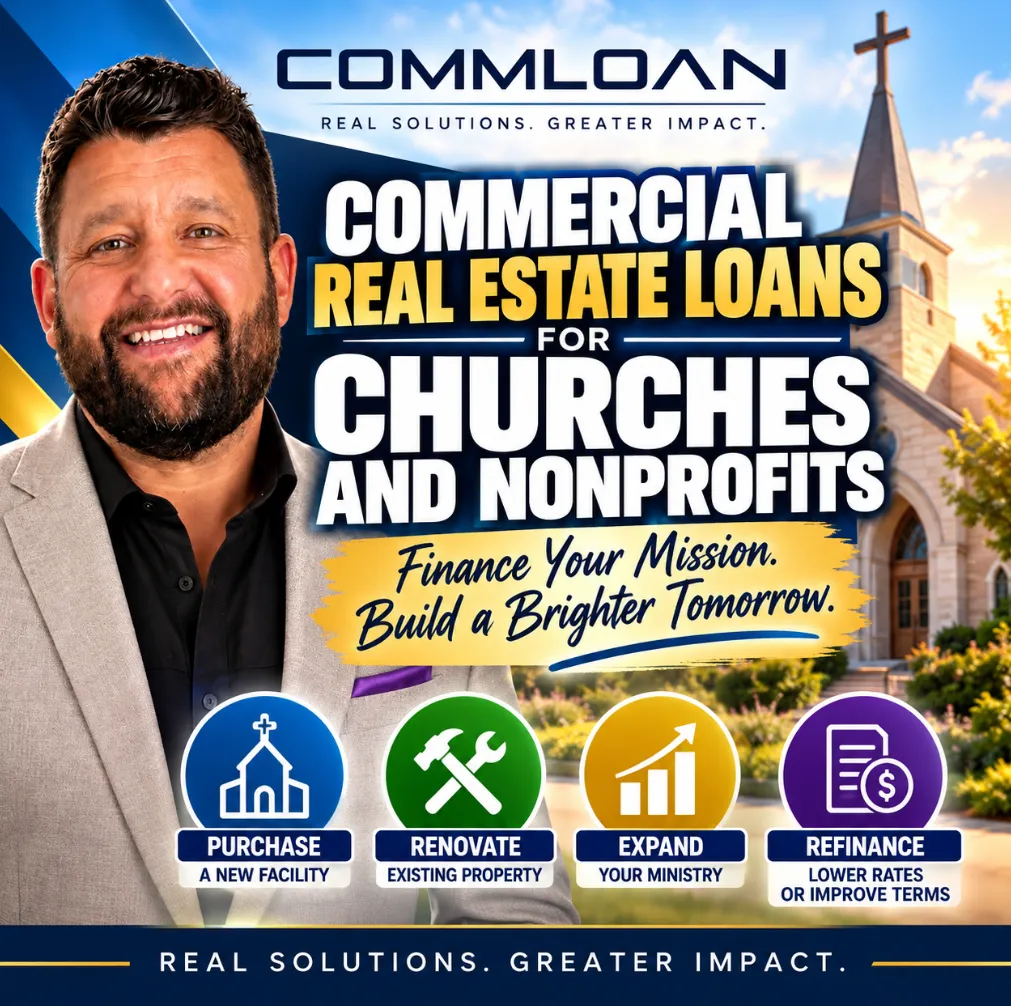
⛪ Commercial Real Estate Loans for Churches and Nonprofits: Your Complete Financing Guide 🏦
⛪ Commercial Real Estate Loans for Churches and Nonprofits: Your Complete Financing Guide 🏦
🙏 Church Building Loans & Nonprofit Real Estate Financing: How to Buy, Build, Expand, or Refinance ⛪
____________________________________________________________________________
Financing Your Mission: Commercial Real Estate Loans for Churches and Nonprofits
For churches, religious organizations, and nonprofit institutions, real estate represents more than a building. It is where communities gather, ministries grow, essential services are delivered, and long-term missions take shape.
Whether your organization wants to purchase its first permanent facility, expand an existing church, renovate a community center, or refinance an existing mortgage, securing the right financing can be one of the most important financial decisions your leadership team makes.
However, commercial real estate loans for churches and nonprofits operate differently from traditional business mortgages.
Churches generally do not generate conventional business profits. Nonprofits may depend on donations, grants, membership contributions, fundraising campaigns, or service-related revenue. Their properties can also be highly specialized, creating unique challenges for lenders.
The good news? Financing opportunities exist beyond traditional community banks.
I'm Bill Rapp, CCIM, a commercial real estate financing advisor with the CommLoan Empower Program. I help organizations evaluate commercial mortgage options, understand lender requirements, and identify financing structures appropriate for their financial circumstances.
In this guide, we'll explore the financing options available, how lenders evaluate churches and nonprofits, and the steps your organization should take before applying.
1. What Are Church and Nonprofit Commercial Real Estate Loans?
A church loan or nonprofit commercial mortgage is financing used by an eligible organization to purchase, construct, renovate, or refinance real estate used in connection with its mission.
Common property types include:
·Churches, sanctuaries, and worship facilities
·Religious education buildings and fellowship halls
·Nonprofit administrative offices and community centers
·Food banks, outreach facilities, and charitable service centers
·Private schools, childcare centers, and educational facilities
·Medical clinics and other qualifying nonprofit-operated facilities
Some organizations purchase existing commercial buildings and convert them into mission-oriented spaces. Others finance ground-up construction or acquire neighboring land for future expansion.
Lenders evaluate the property's use, collateral value, organizational financial strength, and ability to service debt.
2. What Financing Options Are Available for Churches and Nonprofits?
There is no single loan program that works for every organization.
Traditional Bank Church Loans
Community and regional banks may finance established churches and nonprofit organizations with strong financial statements, stable revenue, and demonstrated repayment capacity. Terms may include balloon maturities, amortization schedules longer than the initial fixed-rate period, and guarantees where applicable.
Specialty Religious and Nonprofit Lenders
Certain lenders specialize in religious facilities or mission-driven organizations. They may be more familiar with contribution-based revenue, denominational support, church governance, and specialized collateral.
Private Lending and Bridge Financing
Private lenders or bridge financing providers may consider transactions involving short-term capital needs, renovations, property repositioning, or refinancing deadlines. These loans often have higher costs and shorter terms and require a credible repayment or exit strategy.
Tax-Exempt Bond Financing
Certain qualifying 501(c)(3) nonprofit organizations may access tax-exempt conduit bond financing for eligible capital projects. This structure typically requires specialized legal, tax, and financial analysis and is often more practical for larger projects.
Important SBA clarification: Churches and organizations principally engaged in religious teaching or worship are generally ineligible for SBA 7(a) and 504 financing. Some separately organized nonprofit entities and certain qualifying business activities may have different financing options, but tax-exempt nonprofit status does not itself establish SBA eligibility. SBA 7(a) and 504 loans are generally designed for eligible for-profit small businesses, subject to program-specific rules.
3. How Do Lenders Evaluate Church and Nonprofit Loans?
Lenders focus on several core underwriting considerations.
Cash flow and debt service coverage
The organization must demonstrate sufficient recurring cash flow to cover operating expenses and mortgage obligations.
Church revenue may include tithes, offerings, recurring donations, facility rental income, and other documented income. Nonprofits may receive program service revenue, grants, membership fees, or recurring charitable contributions.
Not all revenue receives equal underwriting treatment. Restricted donations, one-time gifts, and uncertain fundraising pledges may be excluded or discounted.
One commonly used metric is the Debt Service Coverage Ratio (DSCR):
\[ \text{DSCR}=\frac{\text{Cash Flow Available for Debt Service}}{\text{Annual Debt Service}} \]
For example, if an organization has $180,000 in annual cash flow available for debt service and annual mortgage payments of $120,000, its DSCR is 1.50x.
This indicates $1.50 in available cash flow for every $1.00 of required debt payments.
Lenders may apply different definitions and coverage thresholds depending on the organization and loan program.
Loan-to-value ratio
Lenders also examine the relationship between the loan amount and the appraised property value.
\[ \text{LTV}=\frac{\text{Loan Amount}}{\text{Appraised Value}}\times100 \]
Church facilities may receive more conservative leverage treatment because specialized worship properties can have fewer alternative buyers than general-purpose commercial buildings.
Organizational stability
Lenders may review membership or donor trends, revenue consistency, leadership stability, operating history, and financial management practices.
Property characteristics
The appraisal, physical condition, location, zoning, permitted use, environmental condition, and alternative-use potential can all affect financing.
Governance and borrowing authority
Churches and nonprofits may have special requirements for approving debt, pledging real estate, and signing loan documents.
Lenders may require board resolutions, organizational bylaws, articles of incorporation, and evidence that the transaction was properly authorized.
4. How Much Down Payment Is Required?
Down payment requirements vary significantly based on the lender, collateral, organization, and transaction.
For preliminary planning, a church or nonprofit might evaluate a scenario involving 20%–35% equity, although actual lender requirements may be higher or lower.
For a hypothetical $2 million church acquisition:
Item | Illustrative amount |
Purchase price | $2,000,000 |
Equity contribution (25%) | $500,000 |
Loan amount | $1,500,000 |
Loan-to-purchase-price | 75% |
The organization would also need to consider closing costs, inspections, reserves, property improvements, and potential appraisal shortfalls.
Some lenders may require more equity for highly specialized properties, limited operating history, or weaker cash flow.
5. Can a Church Refinance Its Existing Mortgage?
Yes. Refinancing can be an important financial planning tool for churches and nonprofits.
Potential objectives include replacing an upcoming balloon maturity, changing an adjustable-rate structure, extending amortization, consolidating eligible property-related obligations, or financing approved improvements.
However, cash-out refinancing is not universally available for churches and nonprofits. Some lenders offer only rate-and-term refinancing, and others restrict the permitted use of additional loan proceeds.
Before refinancing, organizations should evaluate prepayment penalties, closing costs, current mortgage terms, reserves, and the projected financial benefit.
A lower monthly payment does not automatically mean a lower total borrowing cost.
6. Can Churches Finance New Construction or Expansion?
Church construction loans may be available for new sanctuaries, classrooms, fellowship halls, administrative facilities, and other eligible improvements.
Construction lenders typically evaluate the organization's financial capacity and the project's development feasibility.
Documentation may include architectural plans, construction budgets, permits, contractor qualifications, project schedules, contingency reserves, and evidence of sufficient equity.
A construction-to-permanent financing structure may be available from certain lenders, potentially reducing the need for a separate permanent loan closing.
Before committing to construction, leadership should evaluate cost overruns, fundraising risks, debt capacity, and the impact of construction delays on the organization's operations.
7. What Documents Are Needed for a Church or Nonprofit Loan?
Preparation can substantially improve the financing process.
Lenders commonly request:
1.Two to three years of financial statements and available tax filings or Form 990 returns, as applicable
2.Current year-to-date income statements and balance sheets
3.Recent bank statements and documentation of cash reserves
4.Donation, contribution, membership, or program revenue history
5.Organizational formation documents, bylaws, and governing resolutions
6.Existing mortgage statements and debt schedules
7.Purchase contract, construction plans, or refinance information
8.Property information, insurance details, and available appraisals
Churches are generally not required to file Form 990, so their reporting packages may differ from those of other nonprofit organizations.
Lenders may also request financial projections, fundraising documentation, and evidence of governance approval.
8. Practical Example: A Growing Church Needs a Larger Facility
Consider a hypothetical church in the Greater Houston area that has outgrown its current leased space.
Its leadership identifies an existing commercial building that could be converted into a permanent worship and community facility.
Illustrative financing scenario
Purchase price
$1,800,000
Equity (25%)
$450,000
Proposed loan
$1,350,000
Illustrative DSCR
1.40x
Assumes $210,000 of annual cash flow available for debt service and $150,000 of annual debt service. The figures are hypothetical, not a loan quote or approval.
The church has consistent contribution history, documented reserves, and a board-approved acquisition strategy.
Rather than approaching only one bank, its leadership evaluates several potential financing sources, including community banks and specialty religious-property lenders.
The objective is not simply obtaining a low advertised interest rate. It is finding a financing structure that accommodates the property's use, organizational cash flow, and long-term financial goals.
The church must also budget for conversion costs, accessibility improvements, permitting, and other expenses that may not be covered by the acquisition loan.
9. Five Mistakes Churches and Nonprofits Should Avoid
Mistake 1: Shopping for a property before establishing borrowing capacity. Determine a sustainable debt payment and equity budget before making a major acquisition commitment.
Mistake 2: Assuming all commercial lenders finance churches. Some lenders exclude religious facilities or specialized nonprofit properties from their lending programs.
Mistake 3: Overestimating usable contribution income. Lenders may distinguish recurring unrestricted donations from designated or one-time contributions.
Mistake 4: Ignoring loan maturity risk. A mortgage amortized over 25 years may still mature in five or ten years, requiring refinancing or repayment.
Mistake 5: Comparing loans based only on interest rates. Evaluate amortization, fees, collateral requirements, guarantees, prepayment provisions, and balloon risk.
10. Why Work With a Commercial Mortgage Advisor?
Churches and nonprofits frequently encounter lending challenges that are less common in traditional commercial real estate transactions.
A commercial mortgage advisor can help an organization understand its borrowing profile, prepare a lender-ready financing package, and evaluate potentially suitable lending sources.
Through the CommLoan Empower Program, I work with organizations to evaluate commercial financing alternatives using a marketplace approach and access to a network of 700+ lending relationships.
That network does not mean every lender finances churches or nonprofits. Each transaction must be matched with lenders whose programs accommodate the specific organization, property, and financing request.
My goal is to help leadership make informed decisions and avoid unnecessary financing surprises.
Conclusion: Finance the Property Without Compromising the Mission
Churches and nonprofits need facilities that support their missions, but real estate decisions must also preserve financial stability.
The right financing strategy starts with understanding available cash flow, reserves, property characteristics, organizational authority, and long-term debt obligations.
Whether your organization is buying, building, expanding, or refinancing, thoughtful preparation and appropriate lender selection can make a meaningful difference.
Ready to evaluate financing for your church or nonprofit organization?
Contact Bill Rapp, CCIM, through the CommLoan Empower Program to discuss your real estate financing objectives.
Bill Rapp, CCIM
Director | CommLoan
📞 281-222-0433
📧 [email protected]
🌐 https://billrapp.commloan.com/
🌐 https://HoustonCommercialMortgage.com/
Commercial Real Estate Financing Nationwide
https://billrapp.commloan.com/
https://author.billrapponline.com/
https://www.amazon.com/dp/B0F32Z5BH2
https://veed.cello.so/FOmzTty6oi9
https://buymeacoffee.com/vikingente3
https://creplaybookseries.billrapponline.com
https://creplaybook.billrapponline.com/
©Bill Rapp, CCIM - Director - CommLoan

10 Tips for First-Time Homebuyers

Buying your first home can be both exciting and nerve-wracking at the same time. With so many things to consider and....
How To Choose the Right Lender for You

Lorem Ipsum is simply dummy text of the printing and typesetting industry. Lorem Ipsum has been the industry's standard dummy
Refinancing youe loan and when to do it

Lorem Ipsum is simply dummy text of the printing and typesetting industry. Lorem Ipsum has been the industry's standard dummy
Copyright ©2021 | Mortgage Viking Team
Licensed to Do Business | NMLS # 228246
This is not an offer to enter into an agreement. Not all customers will qualify. Information, rates and programs are subject to change without notice. All products are subject to credit and property approval. Other restrictions and limitations may apply. Copyright © 2021 | Medallion Funds
Corporate | NMLS ID NMLS # 1825831
Corporate Address : 2651 N. Green Valley Pkwy STE. 101 Henderson, NV 89014
Corporate NMLS NMLS # 1825831 | Company Website: https://medallionfunds.com/bill-rapp/
Copyright ©2021 | Mortgage Viking Team Licensed to Do Business | NMLS # 228246
This is not an offer to enter into an agreement. Not all customers will qualify. Information, rates and programs are subject to change without notice. All products are subject to credit and property approval. Other restrictions and limitations may apply
Corporate | NMLS ID NMLS # 1825831
Corporate Address : 2651 N. Green Valley Pkwy STE. 101 Henderson, NV 89014 https://medallionfunds.com/bill-rapp/
Facebook
Instagram
X
LinkedIn
Youtube
TikTok