

Low Rates.
Our rates are low, our application is quick and easy! We can get you clear to close in as little as 10 days!
Trusted By Agents With








Meet Bill Rapp
NMLS ID # NMLS # 228246
Bill Rapp, CCIM is a Houston-based Capital Advisor at Medallion Funds, specializing in commercial real estate finance and strategic lending solutions. With over two decades of experience across brokerage and capital markets, Bill has worked with leading firms including eXp Commercial, NEXA Mortgage, Viking Enterprise LLC, and Sun Realty Houston.
A graduate of Texas A&M University with a BBA in Finance, Bill brings a disciplined, underwriting-first approach to every deal. His expertise spans commercial and residential financing, including asset-based lending, FHA financing, reverse mortgages, REO properties, and investment strategies for both single-family and commercial assets.
Known for his focus on structure over rate, Bill helps investors, business owners, and developers navigate complex transactions with clarity, precision, and a long-term wealth-building mindset.


The Client Experience
Great experience purchasing our first home! Bill was easy to reach and always able to answer any questions or concerns.



Loan Programs Available



Blogs
The Top 5 Mortgage Mistakes to Avoid
Buying your first home can be both exciting and nerve-wracking at the same time. With so many things to consider and....
Mortgage Do and
Do not list

Mortgages can be tricky, and it's easy to make mistakes that can end up costing you dearly. That's why we've put together this list....
Tips On How To Improve Your Credit Score

Let's talk about some ways you can improve your credit score! Your credit score is actually a big deal, and it can affect...
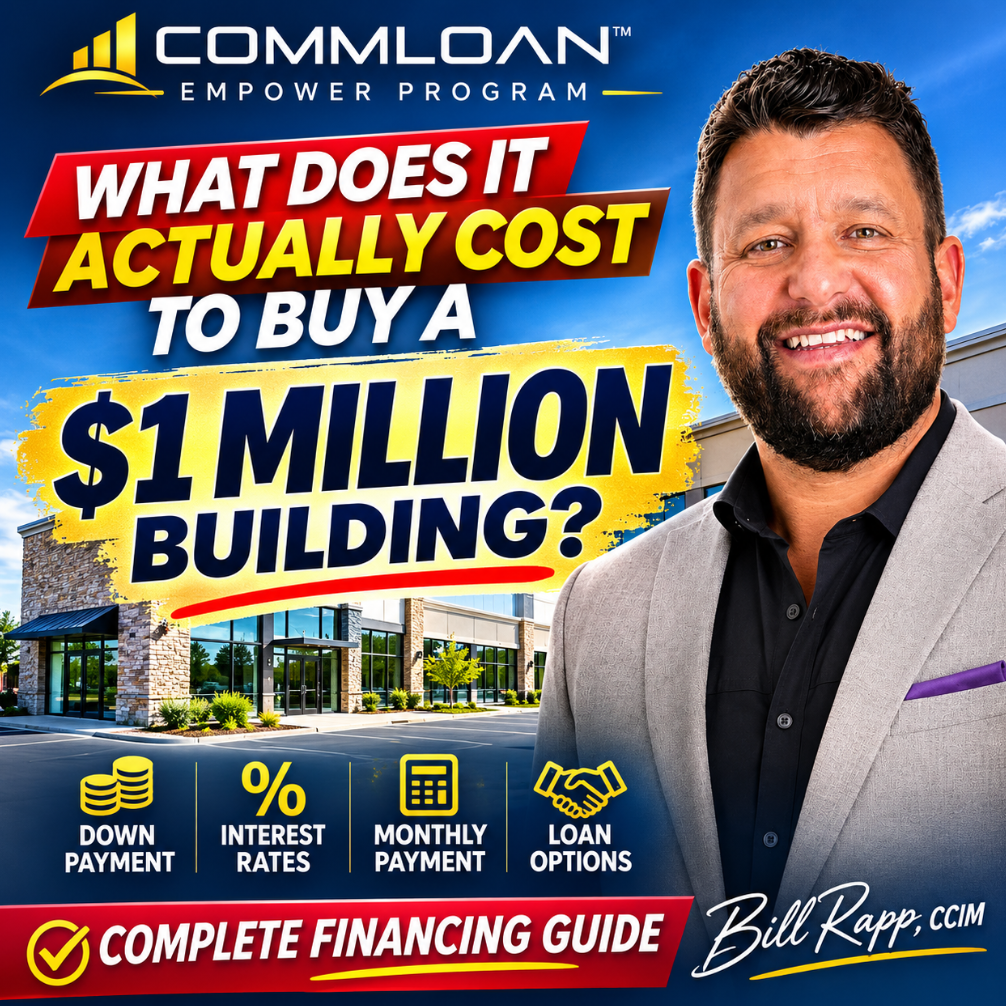
🏢 How to Finance a $1 Million Commercial Property 💰
🏢 How to Finance a $1 Million Commercial Property 💰
💰 $1 Million Commercial Property Loan: True Costs 🏢
________________________________________________________________________________
COMMERCIAL REAL ESTATE FINANCING | NOVEMBER 2026
How to Finance a $1 Million Commercial Property: Down Payments, Loan Options & Real Costs
Buying a $1 million commercial building could be a major step toward building long-term wealth, expanding a business, or generating investment income.
But here's the question many first-time commercial buyers underestimate:
How much money do you actually need to purchase a $1 million commercial property?
Is it $100,000? $250,000? Or potentially more than $350,000?
The answer depends on the property's intended use, financing program, lender requirements, cash flow, and acquisition expenses.
Whether you're buying an office building, retail center, warehouse, medical office, or multifamily property, understanding the capital stack before making an offer can help prevent expensive surprises.
I'm Bill Rapp, CCIM, with CommLoan. In this guide, I'll explain how commercial real estate financing works, what lenders evaluate, and how to prepare for a successful acquisition.
How Much Down Payment Do You Need for a $1 Million Commercial Property?
Unlike residential mortgages, commercial loans are typically structured around the property's operating performance, the borrower's financial strength, and the lender's risk tolerance.
Here is how different down payments affect a $1 million purchase.
Down payment | Loan amount | Buyer equity |
10% | $900,000 | $100,000 |
15% | $850,000 | $150,000 |
20% | $800,000 | $200,000 |
25% | $750,000 | $250,000 |
30% | $700,000 | $300,000 |
35% | $650,000 | $350,000 |
These are illustrative capital structures, not guaranteed financing offers.
For a stabilized investment property, conventional commercial financing commonly requires approximately 20%–35% equity, depending on the lender and property.
Qualified owner-occupied businesses may have access to SBA programs with lower equity requirements.
The important distinction: Your down payment is not your total cash requirement.
Five Ways to Finance a $1 Million Commercial Property
1. Conventional Commercial Real Estate Loan
Conventional commercial mortgages are frequently used to finance stabilized income-producing properties.
Potential property types include retail centers, warehouses, office buildings, multifamily buildings, and mixed-use commercial properties.
Typical characteristics may include:
65%–80% loan-to-value, depending on lender and asset
20%–35% or more borrower equity
Amortization commonly ranging from 20 to 30 years
Loan terms that may range from 3 to 10 years
Personal guarantees or nonrecourse structures, depending on the lender and transaction
For example, a buyer purchasing a $1 million retail property with 75% financing would receive a $750,000 mortgage and contribute $250,000 in equity.
2. SBA 7(a) Financing
An SBA 7(a) loan may be attractive for an eligible operating business purchasing its own commercial property.
Eligible uses can include acquisition, certain improvements, equipment, and other approved business needs.
Some qualifying transactions may be financed with approximately 10% equity, although actual injection requirements vary by project and lender.
The business generally must occupy at least 51% of an existing building, subject to SBA requirements.
A qualifying $1 million acquisition could potentially involve $100,000 of equity and $900,000 of financing, before adjustments for eligible costs and underwriting.
SBA 7(a) real estate loans can have repayment terms of up to 25 years.
3. SBA 504 Financing
SBA 504 financing is another option for eligible owner-occupied commercial real estate.
A common structure involves:
Capital source | Illustrative share |
Third-party lender | 50% |
CDC/SBA-backed financing | 40% |
Borrower contribution | 10% |
For a $1 million eligible project, that could mean $500,000 from a bank, $400,000 through a CDC/SBA-backed structure, and $100,000 in borrower equity.
However, startup businesses, special-purpose properties, and certain other transactions can require larger borrower contributions.
SBA 504 is generally not designed for passive investment real estate.
4. Bridge Loans
Bridge financing may be appropriate when a property needs renovations, lease-up, repositioning, or a faster acquisition timeline.
Bridge loans often feature higher pricing, shorter terms, and interest-only payments.
A buyer acquiring a vacant warehouse for repositioning might use bridge financing initially and refinance into permanent debt after improving occupancy and cash flow.
The exit strategy is critical because refinancing or selling the property must be feasible before the bridge loan matures.
5. CMBS, Life Insurance, and Other Specialty Financing
Some larger or specialized transactions may qualify for CMBS, life insurance company, agency, or other institutional financing.
However, a $1 million transaction is often below the preferred minimum loan size for many institutional lenders.
For smaller commercial acquisitions, banks, credit unions, SBA lenders, and specialty commercial lenders may be more practical starting points.
What Is the Monthly Payment on a $1 Million Commercial Building?
Let's examine a hypothetical purchase using conventional commercial financing.
Illustrative $1 Million Acquisition
Purchase price
$1,000,000
Loan amount (75% LTV)
$750,000
Assumed interest rate
7.00%
Amortization
25 years
Estimated monthly principal & interest
$5,301
Hypothetical fixed-rate amortization, excluding property taxes, insurance, operating expenses, lender fees, and any balloon payment. The 7% rate is an assumption, not a current lender quote.
Use this interactive calculator to see how the financing structure changes the payment.
Commercial Loan Calculator
Illustrative
Property purchase price
$1,000,000
Down payment
25%
Interest rate
7.00%
Amortization
25 years
Estimated monthly principal & interest
$5,301
Loan amount
$750,000
Down payment
$250,000
Annual debt service
$63,610
Copy Loan ScenarioCalculations assume fully amortizing principal and interest at a constant rate. Actual commercial loan terms may differ.
How Much Cash Do You Actually Need to Close?
The down payment is only one component of the acquisition budget.
A buyer may also need cash for lender origination fees, appraisal, environmental assessments, title and escrow, legal work, property inspections, prepaid expenses, and lender-required reserves.
Consider this hypothetical acquisition.
Expense | Estimated amount |
Down payment (25%) | $250,000 |
Origination fee (1% of loan) | $7,500 |
Appraisal and environmental review | $6,000 |
Title, escrow, legal and other closing costs | $12,000 |
Initial operating reserves | $20,000 |
Total estimated cash requirement | $295,500 |
This example illustrates why a buyer planning to contribute $250,000 could need closer to $300,000 in available cash.
Actual closing costs and reserve requirements vary significantly. Taxes, insurance escrows, repairs, and other costs may increase the total.
How Lenders Evaluate a $1 Million Commercial Property Loan
Commercial lenders generally evaluate several underwriting factors.
1. Loan-to-Value (LTV)
LTV measures the loan amount relative to the property's value.
A $750,000 loan on a $1 million property represents 75% LTV, assuming the lender accepts that value.
2. Debt Service Coverage Ratio (DSCR)
DSCR measures a property's net operating income relative to annual debt payments.
\[ DSCR=\frac{Net\ Operating\ Income}{Annual\ Debt\ Service} \]
For example, suppose the building generates $90,000 in annual NOI.
Using the $750,000 loan example above:
Annual debt service: approximately $63,610
Annual NOI: $90,000
DSCR: approximately 1.41x
That may satisfy a lender requiring 1.25x coverage, assuming the lender accepts the NOI and all other requirements are met.
3. Debt Yield
Debt yield measures the relationship between the property's NOI and the proposed loan balance.
\[ Debt\ Yield=\frac{NOI}{Loan\ Amount} \]
With $90,000 NOI and a $750,000 loan, debt yield is 12%.
Some lenders use debt yield alongside LTV and DSCR to determine maximum loan proceeds.
4. Borrower Financial Strength
Lenders may evaluate liquidity, credit history, net worth, global cash flow, experience, contingent liabilities, and existing debt.
5. Property Quality and Market Conditions
Occupancy, tenant credit, lease expirations, location, environmental conditions, property condition, and local market fundamentals can influence approval.
Real-World Example: Two $1 Million Properties, Different Financing Outcomes
Imagine two investors purchasing buildings at the same price.
Property A
Stabilized industrial
$90,000
Annual NOI
1.41x DSCR
At $750K financing, 7%, 25-year amortization
Property B
Partially vacant retail
$55,000
Annual NOI
0.86x DSCR
At the same loan structure
Property A generates sufficient income to cover debt service at the assumed structure with a reasonable cushion.
Property B does not.
If the lender requires 1.25x DSCR and applies the same hypothetical rate and amortization, Property B's DSCR-constrained loan would be approximately $519,000.
That means the investor might need about $481,000 in equity before closing costs—or seek a different financing structure.
The lesson: A $1 million purchase price does not automatically support a $750,000 loan.
How to Improve Your Chances of Commercial Loan Approval
Before submitting a financing request, prepare a complete transaction package.
This should include a current rent roll, historical and year-to-date operating statements, lease agreements, purchase contract, borrower financial statements, entity documents, and a clear business plan.
For owner-occupied financing, business tax returns, financial statements, and evidence of operating cash flow are also important.
A knowledgeable capital advisor can help determine whether the transaction is best suited for a bank, credit union, SBA lender, bridge lender, or another commercial financing source.
Why Compare Multiple Commercial Lenders?
Commercial lenders do not all evaluate risk the same way.
One lender may focus heavily on DSCR, while another may give greater weight to borrower liquidity, tenant quality, industry experience, or collateral.
CommLoan's commercial lending marketplace and CUPID™ technology are designed to help match commercial financing requests with lenders whose programs align with the transaction.
The objective is not simply to find the lowest advertised interest rate. It is to identify an executable financing structure that fits the property's economics and the borrower's objectives.
Frequently Asked Questions
Can I buy a $1 million commercial building with 10% down?
Potentially, through an eligible SBA owner-occupied transaction. A conventional investment-property acquisition generally requires more equity.
What credit score is needed for a commercial property loan?
There is no universal minimum. Requirements depend on the lender, program, borrower, and transaction.
Can rental income qualify me for a commercial mortgage?
Yes. For income-producing commercial real estate, lenders commonly evaluate property NOI, DSCR, leases, and borrower financial strength.
Can I finance a vacant commercial building?
Possibly. Financing may involve a larger equity contribution, a bridge loan, or an owner-occupied program, depending on the acquisition plan.
How long does commercial financing take?
Some transactions close within several weeks, while more complex SBA, construction, environmental, or institutional transactions may take substantially longer.
Final Thoughts: Finance the Property, Not Just the Purchase Price
A $1 million commercial building can require substantially more cash than the advertised down payment suggests.
Before making an offer, evaluate your loan options, closing costs, lender reserves, property cash flow, and financing contingency.
The right financing strategy can help preserve liquidity, improve execution, and support long-term investment performance.
Ready to explore commercial financing?
I'm Bill Rapp, CCIM, with CommLoan. I help commercial property buyers, business owners, investors, and CRE professionals understand financing structures and navigate the commercial lending marketplace.
Top of Form
Bottom of Form
Bill Rapp, CCIM
Director | CommLoan
📞 281-222-0433
📧 [email protected]
🌐 https://billrapp.commloan.com/
🌐 https://HoustonCommercialMortgage.com/
Commercial Real Estate Financing Nationwide
https://billrapp.commloan.com/
https://author.billrapponline.com/
https://www.amazon.com/dp/B0F32Z5BH2
https://veed.cello.so/FOmzTty6oi9
https://buymeacoffee.com/vikingente3
https://creplaybookseries.billrapponline.com
https://creplaybook.billrapponline.com/
©Bill Rapp, CCIM - Director - CommLoan

10 Tips for First-Time Homebuyers

Buying your first home can be both exciting and nerve-wracking at the same time. With so many things to consider and....
How To Choose the Right Lender for You

Lorem Ipsum is simply dummy text of the printing and typesetting industry. Lorem Ipsum has been the industry's standard dummy
Refinancing youe loan and when to do it

Lorem Ipsum is simply dummy text of the printing and typesetting industry. Lorem Ipsum has been the industry's standard dummy
Copyright ©2021 | Mortgage Viking Team
Licensed to Do Business | NMLS # 228246
This is not an offer to enter into an agreement. Not all customers will qualify. Information, rates and programs are subject to change without notice. All products are subject to credit and property approval. Other restrictions and limitations may apply. Copyright © 2021 | Medallion Funds
Corporate | NMLS ID NMLS # 1825831
Corporate Address : 2651 N. Green Valley Pkwy STE. 101 Henderson, NV 89014
Corporate NMLS NMLS # 1825831 | Company Website: https://medallionfunds.com/bill-rapp/
Copyright ©2021 | Mortgage Viking Team Licensed to Do Business | NMLS # 228246
This is not an offer to enter into an agreement. Not all customers will qualify. Information, rates and programs are subject to change without notice. All products are subject to credit and property approval. Other restrictions and limitations may apply
Corporate | NMLS ID NMLS # 1825831
Corporate Address : 2651 N. Green Valley Pkwy STE. 101 Henderson, NV 89014 https://medallionfunds.com/bill-rapp/
Facebook
Instagram
X
LinkedIn
Youtube
TikTok