

Low Rates.
Our rates are low, our application is quick and easy! We can get you clear to close in as little as 10 days!
Trusted By Agents With








Meet Bill Rapp
NMLS ID # NMLS # 228246
Bill Rapp, CCIM is a Houston-based Capital Advisor at Medallion Funds, specializing in commercial real estate finance and strategic lending solutions. With over two decades of experience across brokerage and capital markets, Bill has worked with leading firms including eXp Commercial, NEXA Mortgage, Viking Enterprise LLC, and Sun Realty Houston.
A graduate of Texas A&M University with a BBA in Finance, Bill brings a disciplined, underwriting-first approach to every deal. His expertise spans commercial and residential financing, including asset-based lending, FHA financing, reverse mortgages, REO properties, and investment strategies for both single-family and commercial assets.
Known for his focus on structure over rate, Bill helps investors, business owners, and developers navigate complex transactions with clarity, precision, and a long-term wealth-building mindset.


The Client Experience
Great experience purchasing our first home! Bill was easy to reach and always able to answer any questions or concerns.



Loan Programs Available




Blogs
The Top 5 Mortgage Mistakes to Avoid

Buying your first home can be both exciting and nerve-wracking at the same time. With so many things to consider and....
Mortgage Do and
Do not list

Mortgages can be tricky, and it's easy to make mistakes that can end up costing you dearly. That's why we've put together this list....
Tips On How To Improve Your Credit Score

Let's talk about some ways you can improve your credit score! Your credit score is actually a big deal, and it can affect...
🚨 CMBS Loan Maturities: Extend-and-Pretend Fails! 📉
🚨 CMBS Loan Maturities: Extend-and-Pretend Fails! 📉
🏢 Commercial Real Estate Debt Crisis: 2027 Outlook ⚠️
_________________________________________________________________________
CMBS Loan Maturities: Why Extend-and-Pretend Is Failing Heading Into 2027
With $71.7 billion in CMBS loans under special servicing, commercial real estate owners face mounting refinancing pressure. Learn why loan extensions are losing effectiveness and what investors should do next.
The Commercial Real Estate Debt Problem Is Getting Harder to Ignore
For the past several years, commercial real estate lenders have relied on a relatively straightforward strategy for troubled loans: extend the maturity date, modify the terms, and give property owners additional time to recover.
The industry calls this approach extend-and-pretend.
The expectation was that interest rates would eventually decline, property values would stabilize, and borrowers would refinance their loans under more favorable conditions.
But what happens when those improvements never fully materialize?
According to Trepp CMBS research discussed in a November 18, 2026 GlobeSt article by Erik Sherman, the effectiveness of these loan modifications is deteriorating.
The consequences could extend well beyond the borrowers directly involved.
Commercial property investors, lenders, and business owners may face an increasingly active market for distressed asset sales, refinancing shortfalls, recapitalizations, and loan restructurings heading into 2027.
What Is the Extend-and-Pretend Strategy?
Extend-and-pretend is an informal industry term describing situations in which lenders extend troubled commercial mortgages rather than immediately pursuing foreclosure or another final resolution.
Consider a commercial office property with a $5 million mortgage approaching maturity.
The property was originally financed when borrowing costs were lower and valuations were stronger.
Today, the building might have higher vacancy, declining net operating income, and a lower appraised value.
If the borrower cannot refinance the existing mortgage, the lender may agree to extend the maturity date.
That extension can be reasonable when the property has a credible recovery plan. However, if the underlying cash flow and valuation remain insufficient, the extension may simply postpone an eventual loss.
The critical distinction is whether the loan modification creates a sustainable path to repayment or merely delays recognizing the problem.
The Numbers Behind the CMBS Distress
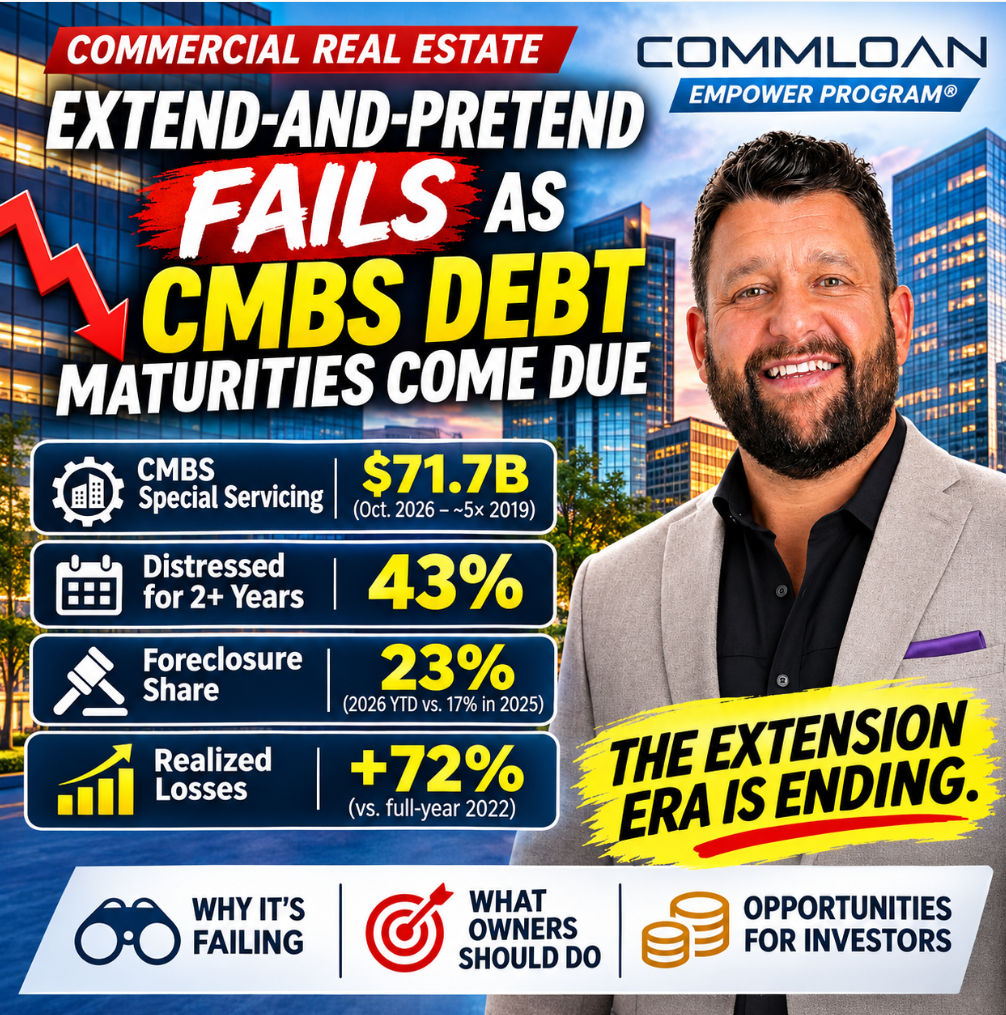
$71.7B
CMBS special servicing
October 2026
43%
Distressed for 2+ years
Share of specially serviced debt
23%
Foreclosure share
2026 year to date
+72%
Realized loan losses
2026 through October vs. 2022
Source: Trepp CMBS research, as summarized in the supplied November 18, 2026 GlobeSt reporting. These figures describe different populations and periods.
These statistics highlight a market in which distressed commercial mortgages are taking longer to resolve and more loans are reaching adverse outcomes.
1. Loan modifications are declining
Modifications as a share of special-servicing exits
Percentage of balances exiting special servicing through modifications
0%15%30%45%60%202420252026 YTD
In 2024, loan modifications represented 54% of balances exiting special servicing. That declined to 49% in 2025 and 37% in 2026.
The decline suggests that fewer troubled loans are finding resolution through modifications.
Importantly, this does not mean every modification failed. It indicates a changing mix of resolutions, with a greater role for other workout outcomes.
2. Foreclosures are increasing
Foreclosures accounted for 17% of special-servicing exits in 2025, compared with 23% during 2026 year to date.
Foreclosure resolutions averaged approximately 40 months, versus 10 months for loans successfully cured.
Longer resolutions can increase legal expenses, servicing costs, property deterioration risks, and uncertainty over ultimate recoveries.
3. Repeat distress is becoming more common
Approximately 26% of loans cured in 2025 returned to special servicing within 12 months, compared with 17% in the 2022 comparison cohort.
This is particularly important.
A loan leaving special servicing does not necessarily mean the property's financial problems have been permanently resolved.
A property might obtain temporary relief but continue struggling with tenant departures, inadequate cash flow, or refinancing constraints.
4. The distressed loan backlog is aging
Approximately 43% of the $71.7 billion in specially serviced CMBS loans had remained unresolved for at least two years.
That compares with 28% at year-end 2024.
The growing proportion of long-term distressed loans raises questions about collateral recovery, future asset sales, and the timing of price discovery.
5. Realized losses are rising
The research also indicates that realized CMBS losses through October 2026 were approximately 72% higher than the full-year 2022 comparison.
Separately, the proportion of non-payoff special-servicing exits resulting in losses increased 78% since 2022.
These are different measures: one concerns realized loss amounts, while the other concerns the frequency of loss-producing resolutions.
Both point toward greater pressure on distressed loan recoveries.
Why Commercial Mortgage Refinancing Is Becoming More Difficult
Commercial mortgage approval is not determined solely by the borrower's payment history.
Lenders also evaluate the property's ability to support new debt.
Three underwriting metrics are particularly important.
Debt-Service Coverage Ratio (DSCR)
DSCR compares net operating income with annual debt service.
\[ DSCR=\frac{NOI}{Annual\ Debt\ Service} \]
For example, a property generating $400,000 in annual NOI with $320,000 in annual debt service has a DSCR of 1.25.
If NOI falls or refinancing debt service rises, the ratio deteriorates.
Loan-to-Value Ratio (LTV)
LTV measures the loan relative to the property's appraised value.
\[ LTV=\frac{Loan\ Amount}{Property\ Value} \]
A $4 million loan against a $5 million property represents 80% LTV.
If the property's valuation falls to $4.5 million, the same loan represents approximately 88.9% LTV.
Debt Yield
Debt yield measures NOI relative to the loan balance.
\[ Debt\ Yield=\frac{NOI}{Loan\ Amount} \]
A property generating $400,000 in NOI against a $4 million loan produces a 10% debt yield.
At a 12% required debt yield, the same property would support approximately $3.33 million in debt, before considering other underwriting constraints.
This illustrates why a loan that worked several years ago might no longer qualify for the same proceeds.
Real-World Example: A $5 Million Loan Approaching Maturity
Consider an illustrative office or retail investment property.
Underwriting factor | Original position | Current position |
Property value | $7,000,000 | $5,500,000 |
Annual NOI | $500,000 | $400,000 |
Mortgage balance | $5,000,000 | $5,000,000 |
LTV on existing debt | 71.4% | 90.9% |
Debt yield on existing debt | 10.0% | 8.0% |
Now assume a refinancing lender requires a 12% minimum debt yield and a maximum 70% LTV.
Illustrative refinance proceeds
Debt yield limit
$3.33M
70% LTV limit
$3.85M
Binding constraint: debt yield
$1.67M
Potential refinancing shortfall
Before closing costs, reserves, and any additional DSCR restrictions.
Even though the borrower owes $5 million, the lender may only offer approximately $3.33 million.
The owner must address a shortfall of approximately $1.67 million.
Potential solutions include contributing additional equity, negotiating a principal reduction, obtaining subordinate capital where permitted, selling the asset, or pursuing another lender or restructuring solution.
An extension alone does not eliminate that shortfall.
What This Means for Commercial Real Estate Investors
For investors with sufficient liquidity, distressed commercial real estate can create acquisition opportunities.
However, buying a distressed property is not automatically the same as buying an undervalued property.
Investors should carefully evaluate:
Sustainable NOI rather than optimistic projections.
Deferred maintenance and future capital expenditures.
Lease expirations, tenant credit, and rollover exposure.
Property taxes, insurance, and operating expenses.
Realistic exit capitalization rates and refinancing assumptions.
Whether the acquisition price provides an adequate risk-adjusted return.
A discounted acquisition can still produce disappointing results if the property requires substantially more capital than originally anticipated.
What Commercial Property Owners Should Do Before Loan Maturity
Owners approaching commercial mortgage maturity should begin evaluating their options well before the payoff date.
A practical starting point is 12–24 months ahead of maturity for complex or potentially distressed transactions.
Review the loan documents for maturity provisions, extension options, covenants, prepayment restrictions, and any required notices.
Next, update the property's financial package.
Lenders will typically want current rent rolls, trailing operating statements, historical financials, borrower financial information, and relevant lease documentation.
Owners should also obtain realistic refinance estimates based on today's property performance.
If the available proceeds will not cover the existing debt, identifying that gap early creates more options.
Waiting until the final months before maturity can severely limit negotiating flexibility.
Houston, Katy, and West Houston: What Investors Should Watch
National CMBS distress trends deserve attention across the Houston commercial real estate market.
However, national CMBS statistics should not be interpreted as direct evidence that Houston has identical distress levels.
Potentially vulnerable assets include office properties with elevated vacancy, retail centers with weakening tenant performance, multifamily properties facing operating-cost pressure, and industrial properties with concentrated tenant rollover.
In Katy, Fulshear, Brookshire, the Energy Corridor, and West Houston, investors should examine local lease demand, property-specific NOI, financing structures, and upcoming maturity schedules.
Properties with strong locations, durable tenant demand, and conservative leverage may remain attractive even as weaker assets face restructuring pressure.
For well-capitalized buyers, lender-driven sales or ownership recapitalizations could create opportunities.
For existing owners, the priority should be preserving flexibility before a maturity becomes a crisis.
How CommLoan Helps Commercial Borrowers Evaluate Financing Options
Commercial real estate financing is rarely a one-size-fits-all process.
Different lenders can reach different conclusions about the same property's risk, loan structure, amortization, and available proceeds.
Through CommLoan's commercial financing marketplace, borrowers can explore financing alternatives across participating lenders and loan programs.
Depending on the property and borrower, potential financing paths may include conventional commercial mortgages, bridge financing, CMBS alternatives, or eligible SBA financing for owner-occupied properties.
A financing review should examine not only the interest rate but also loan proceeds, debt-service requirements, recourse, reserves, maturity structure, and total transaction costs.
The 2027 Outlook: Prepare for More Price Discovery
The central issue facing commercial real estate is no longer simply the volume of loans reaching maturity.
It is whether current property values and operating income can support the amount of debt that needs to be refinanced.
As extensions expire, some owners may refinance successfully, others may contribute additional capital, and some properties may be sold or transferred through foreclosure.
The outcomes will differ by asset class, geography, sponsorship, and loan structure.
The key lesson for 2027 is that time alone does not repair a capital structure. Sustainable property cash flow, realistic valuations, and adequate liquidity remain essential.
Work With Bill Rapp, CCIM — CommLoan
If your commercial mortgage is approaching maturity, your refinancing proceeds are uncertain, or you are evaluating a distressed property acquisition, an early financing review can help clarify the available options.
I'm Bill Rapp, CCIM, and I help commercial real estate investors and business owners evaluate financing structures and lender alternatives through CommLoan.
Disclaimer: This article is educational and does not constitute a loan commitment, investment recommendation, or legal or tax advice. All financing is subject to lender underwriting, property eligibility, and program requirements.
Source attribution: Erik Sherman, GlobeSt, November 18, 2026, reporting on Trepp CMBS special-servicing and loan-resolution research. Statistics above reflect the supplied research summary.
Top of Form
Bottom of Form
Bill Rapp, CCIM
Director | CommLoan
📞 281-222-0433
📧 [email protected]
🌐 https://billrapp.commloan.com/
🌐 https://HoustonCommercialMortgage.com/
Commercial Real Estate Financing Nationwide
https://billrapp.commloan.com/
https://author.billrapponline.com/
https://www.amazon.com/dp/B0F32Z5BH2
https://veed.cello.so/FOmzTty6oi9
https://buymeacoffee.com/vikingente3
https://creplaybookseries.billrapponline.com
https://creplaybook.billrapponline.com/
©Bill Rapp, CCIM - Director - CommLoan

10 Tips for First-Time Homebuyers

Buying your first home can be both exciting and nerve-wracking at the same time. With so many things to consider and....
How To Choose the Right Lender for You

Lorem Ipsum is simply dummy text of the printing and typesetting industry. Lorem Ipsum has been the industry's standard dummy
Refinancing youe loan and when to do it

Lorem Ipsum is simply dummy text of the printing and typesetting industry. Lorem Ipsum has been the industry's standard dummy

Copyright ©2021 | Mortgage Viking Team
Licensed to Do Business | NMLS # 228246
This is not an offer to enter into an agreement. Not all customers will qualify. Information, rates and programs are subject to change without notice. All products are subject to credit and property approval. Other restrictions and limitations may apply. Copyright © 2021 | Medallion Funds
Corporate | NMLS ID NMLS # 1825831
Corporate Address : 2651 N. Green Valley Pkwy STE. 101 Henderson, NV 89014
Corporate NMLS NMLS # 1825831 | Company Website: https://medallionfunds.com/bill-rapp/
Copyright ©2021 | Mortgage Viking Team Licensed to Do Business | NMLS # 228246
This is not an offer to enter into an agreement. Not all customers will qualify. Information, rates and programs are subject to change without notice. All products are subject to credit and property approval. Other restrictions and limitations may apply
Corporate | NMLS ID NMLS # 1825831
Corporate Address : 2651 N. Green Valley Pkwy STE. 101 Henderson, NV 89014 https://medallionfunds.com/bill-rapp/
Facebook
Instagram
X
LinkedIn
Youtube
TikTok