


The Top 5 Mortgage Mistakes to Avoid
Buying a home can be an exciting and rewarding experience, but it can also be a daunting and overwhelming process, especially for first-time homebuyers.
.
Mortgages are a significant financial commitment, and making mistakes during the process can have serious consequences. In this blog post, we'll explore the top 5 mortgage mistakes to avoid.

1. Failing to Check and Improve Your
Credit Score
Your credit score plays a significant role in determining your eligibility for a mortgage and the interest rate you'll receive. Many first-time homebuyers make the mistake of failing to check their credit score or not taking steps to improve it before applying for a mortgage.
,
To avoid this mistake, check your credit score and take steps to improve it if necessary. This may include paying off outstanding debts, making on-time payments, and disputing any errors on your credit report. A higher credit score can lead to a lower interest rate and a more favorable mortgage offer.

2. Ignoring
Closing Costs
Another common mistake is ignoring closing costs. Many first-time homebuyers are unaware of the various fees associated with closing a mortgage, such as attorney fees, title search fees, and appraisal fees. These costs can add up quickly and significantly impact the total cost of the mortgage.
.
To avoid this mistake, research the average closing costs in your area and budget accordingly. Be sure to factor in these costs when considering the overall cost of the home.
2. Ignoring Closing Costs
Another common mistake is ignoring closing costs. Many first-time homebuyers are unaware of the various fees associated with closing a mortgage, such as attorney fees, title search fees, and appraisal fees. These costs can add up quickly and significantly impact the total cost of the mortgage.
.
To avoid this mistake, research the average closing costs in your area and budget accordingly. Be sure to factor in these costs when considering the overall cost of the home.

3. Not Getting Pre-Approved
Getting pre-approved for a mortgage is an essential step in the home buying process. Pre-approval gives you a clear idea of how much you can afford to spend on a home and helps you avoid the disappointment of falling in love with a home you can't afford.
.
To avoid this mistake, get pre-approved for a mortgage before you start shopping for a home. This will help you narrow down your search to homes that are within your budget and prevent you from wasting time on homes that are out of reach.

4. Taking on Too Much Debt
Taking on too much debt before or during the mortgage process can have serious consequences. Lenders look at your debt-to-income ratio when determining your eligibility for a mortgage. If you have too much debt, you may not qualify for a mortgage or may be offered a higher interest rate.
.
To avoid this mistake, avoid taking on new debt before or during the mortgage process. This includes opening new credit cards, taking out a car loan, or making large purchases on existing credit cards.
4. Taking on Too
Much Debt
Taking on too much debt before or during the mortgage process can have serious consequences. Lenders look at your debt-to-income ratio when determining your eligibility for a mortgage. If you have too much debt, you may not qualify for a mortgage or may be offered a higher interest rate.
.
To avoid this mistake, avoid taking on new debt before or during the mortgage process. This includes opening new credit cards, taking out a car loan, or making large purchases on existing credit cards.

5. Choosing the Wrong Mortgage
Choosing the wrong mortgage can be a costly mistake. There are various types of mortgages available, and each has its pros and cons. Choosing the wrong mortgage can lead to higher interest rates, higher monthly payments, and a more significant financial burden in the long run.
.
To avoid this mistake, research the different types of mortgages available and choose the one that best fits your financial situation and goals. Don't be afraid to ask your lender questions and seek advice from a financial advisor.
Blogs
The Top 5 Mortgage Mistakes to Avoid

Buying your first home can be both exciting and nerve-wracking at the same time. With so many things to consider and....
Mortgage Do and
Do not list

Mortgages can be tricky, and it's easy to make mistakes that can end up costing you dearly. That's why we've put together this list....
Tips On How To Improve Your Credit Score

Let's talk about some ways you can improve your credit score! Your credit score is actually a big deal, and it can affect...
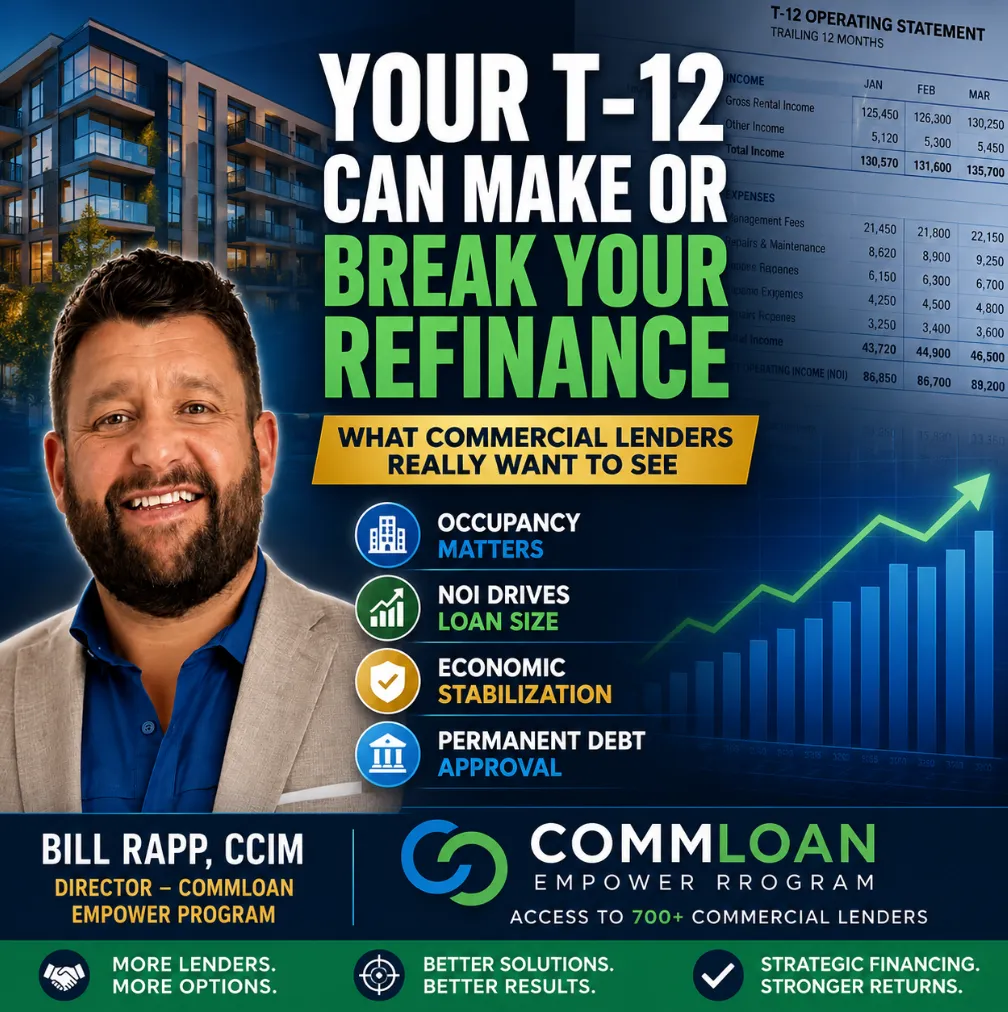
📊 How T-12 Statements Drive Commercial Loan Approvals & Value-Add Refinancing 🏢
📊 How T-12 Statements Drive Commercial Loan Approvals & Value-Add Refinancing 🏢
💰 From Value-Add to Permanent Financing: Why Your T-12 Statement Matters 📈
How T-12 Statements Affect Commercial Real Estate Lending
Why Property Performance Determines Your Ability to Refinance into Permanent Debt
One of the biggest misconceptions among commercial real estate investors is believing that completing renovations automatically qualifies a property for permanent financing.
It doesn't.
The lender isn't financing your renovations—they're financing your property's ability to consistently generate income.
That's where the Trailing 12-Month Operating Statement (T-12) becomes one of the most important documents in commercial lending.
Whether you're buying an apartment complex, retail center, office building, industrial property, or self-storage facility, your T-12 tells lenders whether your value-add strategy has truly succeeded.
If your property has achieved economic stabilization, refinancing into lower-cost permanent debt becomes dramatically easier.
What Is a T-12 Statement?
A T-12 (Trailing Twelve Months Operating Statement) summarizes the property's financial performance over the previous twelve months.
It typically includes:
·Gross Rental Income
·Other Income
·Vacancy Loss
·Bad Debt
·Operating Expenses
·Net Operating Income (NOI)
·Monthly income trends
·Expense trends
Unlike a budget or pro forma, a T-12 reflects actual operating history.
Lenders trust historical performance far more than future projections.
Why Permanent Lenders Focus on the T-12
Bridge lenders often finance based upon potential.
Permanent lenders finance proven performance.
By the time you refinance, lenders want evidence that your business plan has worked.
Questions they ask include:
·Has occupancy stabilized?
·Are rents sustainable?
·Are expenses under control?
·Is cash flow consistent?
·Can the property comfortably service the new loan?
The answers are found inside the T-12.
The Value-Add Timeline
A typical value-add investment follows this progression:
Step 1: Acquisition
The investor purchases an underperforming property with low occupancy or below-market rents.
Examples include:
·Deferred maintenance
·Poor management
·Vacant units
·Under-market leases
·Operational inefficiencies
Step 2: Bridge Financing
Bridge loans provide the flexibility needed to execute the business plan.
Capital is used for:
·Renovations
·Leasing commissions
·Marketing
·Capital improvements
·Tenant improvements
·Operational improvements
Step 3: Improve Occupancy
As renovations are completed:
·Vacancy declines
·Tenants renew
·New tenants lease vacant space
·Rental income increases
Occupancy begins to stabilize.
Step 4: Increase Net Operating Income
As revenue grows while expenses remain controlled:
NOI improves.
This is the number permanent lenders care about most.
Higher NOI means:
·Higher valuation
·Better loan terms
·Increased proceeds
·Lower refinance risk
Economic Occupancy vs Physical Occupancy
Many investors focus only on physical occupancy.
Lenders don't.
Physical Occupancy
The percentage of units currently occupied.
Example:
90 of 100 units leased
= 90% Physical Occupancy
Economic Occupancy
The percentage of collectible income actually received.
It considers:
·Free rent
·Concessions
·Delinquencies
·Bad debt
·Vacant units
Example:
95% physical occupancy
Only 87% economic occupancy
Permanent lenders underwrite economic occupancy because income—not leased space—repays loans.
What Is Economic Stabilization?
Economic stabilization means the property has achieved consistent financial performance over time.
Typical indicators include:
✓ Strong occupancy
✓ Stable rental collections
✓ Positive NOI
✓ Limited deferred maintenance
✓ Predictable operating expenses
✓ Sustainable rental rates
This demonstrates the business plan has transitioned from "improving" to "performing."
Why Seasoning Matters
Many investors ask:
"We finished renovations—why can't we refinance immediately?"
Because lenders want to see that the improved performance is sustainable.
Most permanent lenders prefer several months of stabilized operations reflected in the T-12 before refinancing.
This reduces underwriting risk and confirms that recent improvements are durable rather than temporary.
The Relationship Between NOI and Loan Amount
Commercial loans are driven by income.
As NOI increases:
·Debt Service Coverage Ratio (DSCR) improves
·Loan proceeds increase
·Property valuation rises
·Cap rates create greater equity
·Refinance options expand
Even modest increases in NOI can translate into substantial gains in property value.
For many investors, improving operations—not simply renovating buildings—creates the greatest return on investment.
Common Mistakes That Delay Refinancing
Many investors inadvertently postpone their refinance because they refinance before their financials tell the full story.
Common issues include:
·Occupancy hasn't stabilized
·Collections remain inconsistent
·High delinquency rates
·Expenses spike after renovations
·Short operating history
·Poor bookkeeping
·Incomplete T-12 statements
Every one of these concerns increases lender risk.
How Investors Can Prepare for Permanent Financing
Before refinancing, ensure your property demonstrates:
·Stable occupancy
·Strong economic occupancy
·Consistent collections
·Healthy NOI
·Accurate financial reporting
·Clean rent roll
·Well-maintained property
·Predictable operating expenses
When these elements align, permanent lenders compete aggressively for the opportunity to finance your asset.
Why Working with an Experienced Capital Advisor Matters
Every lender evaluates T-12 statements a little differently.
Some prioritize occupancy.
Others focus on DSCR.
Others emphasize debt yield, liquidity, sponsorship strength, or market fundamentals.
Working with an experienced capital advisor helps position your financial package before it reaches lenders, improving the likelihood of stronger terms and a smoother refinance process.
At CommLoan, our platform provides access to more than 700 commercial lending sources, allowing investors to compare financing options from banks, credit unions, agency lenders, debt funds, life companies, and other institutional capital providers.
That means you receive financing matched to your property's actual performance—not just a single lender's lending guidelines.
Final Thoughts
Successful value-add investing doesn't end when renovations are complete.
It ends when your property's financial performance demonstrates long-term stability.
A strong T-12 tells lenders the story they want to hear:
The property is leased, cash flowing, economically stable, and ready for permanent financing.
Understanding how lenders analyze T-12 statements allows investors to refinance sooner, secure better loan terms, increase proceeds, and maximize long-term returns.
If you're considering refinancing a value-add property, the best first step is a detailed review of your property's operating performance before approaching lenders.
Ready to Refinance Your Commercial Property?
Whether you're exiting bridge financing or planning your next acquisition, I can help you evaluate your property's readiness for permanent financing and identify the right lending solution.
Bill Rapp, CCIM
Director | CommLoan
📞 281-222-0433
📧 [email protected]
🌐 https://billrapp.commloan.com/
🌐 https://HoustonCommercialMortgage.com/
Commercial Real Estate Financing Nationwide
https://billrapp.commloan.com/
https://author.billrapponline.com/
https://www.amazon.com/dp/B0F32Z5BH2
https://veed.cello.so/FOmzTty6oi9
https://buymeacoffee.com/vikingente3
https://creplaybookseries.billrapponline.com
https://creplaybook.billrapponline.com/
©Bill Rapp, CCIM - Director - CommLoan

10 Tips for First-Time Homebuyers

Buying your first home can be both exciting and nerve-wracking at the same time. With so many things to consider and....
How To Choose the Right Lender for You

Lorem Ipsum is simply dummy text of the printing and typesetting industry. Lorem Ipsum has been the industry's standard dummy
Refinancing youe loan and when to do it

Lorem Ipsum is simply dummy text of the printing and typesetting industry. Lorem Ipsum has been the industry's standard dummy
🧮 Renovation ROI Calculator
🛠️ Renovation ROI Calculator 💰

Copyright ©2021 | Mortgage Viking Team
Licensed to Do Business | NMLS # 228246
This is not an offer to enter into an agreement. Not all customers will qualify. Information, rates and programs are subject to change without notice. All products are subject to credit and property approval. Other restrictions and limitations may apply. Copyright © 2021 | Medallion Funds
Corporate | NMLS ID NMLS # 1825831
Corporate Address : 2651 N. Green Valley Pkwy STE. 101 Henderson, NV 89014
Corporate NMLS NMLS # 1825831 | Company Website: https://medallionfunds.com/bill-rapp/
Copyright ©2021 | Mortgage Viking Team Licensed to Do Business | NMLS # 228246
This is not an offer to enter into an agreement. Not all customers will qualify. Information, rates and programs are subject to change without notice. All products are subject to credit and property approval. Other restrictions and limitations may apply
Corporate | NMLS ID NMLS # 1825831
Corporate Address : 2651 N. Green Valley Pkwy STE. 101 Henderson, NV 89014 https://medallionfunds.com/bill-rapp/